
What Are the Four Gospels?
The four works known today as the Gospels of Matthew, Mark, Luke and John occupy the opening position in the New Testament. In Christianity they are treated as four authoritative accounts of Jesus. Historically, however, their status developed over time and should not simply be projected backwards onto the period in which the individual works were first produced.
The word “gospel” itself has a broader history than the four books now found in the New Testament. The Greek term euangelion originally meant “good news” or “good message” and was used in early Christian literature before it became the standard designation for a written account of Jesus. Oxford scholarship notes that Paul used the term before the authors of the canonical Gospels employed it in connection with their works. [1]
The four Gospel texts therefore need to be distinguished from the later concept of the Four Gospels as a fixed collection. Early Christianity produced more than four writings concerning Jesus. A number of other works were also known as gospels, and some have survived either completely or in fragments. The fact that four particular works eventually received canonical status does not by itself establish that they were the only Gospel writings circulating in the earliest period. [2]
The four works themselves are also not straightforwardly identified by their authors. The texts commonly called Matthew, Mark, Luke and John are internally anonymous. Their traditional names became attached to them through early Christian transmission and attribution rather than through explicit authorial statements in the texts themselves. A Cambridge treatment of the Gospel evidence notes that the traditional attribution of these works to Matthew, Mark, Luke and John goes back to the second century, while the books themselves do not provide straightforward authorial identifications. [3]
This creates an important distinction between three different things:
- The Gospel texts themselves — the ancient writings that have survived through manuscript transmission.
- The names traditionally attached to those writings — Matthew, Mark, Luke and John.
- The later collection of these four works as the authoritative fourfold Gospel — a development in the history of Christianity.
These three things should not be treated as though they arose simultaneously.
The Fourfold Gospel
Evidence from the second century shows that Christians were increasingly reading multiple Gospel texts together. By the later second century, Irenaeus explicitly defended a fourfold Gospel consisting of Matthew, Mark, Luke and John. Earlier evidence may point to a four-Gospel collection already existing before Irenaeus, but the precise point at which this collection became fixed and authoritative remains a historical question. [4]
This development is significant because it demonstrates that the existence of the four Gospels as a collection is later than the existence of the individual texts themselves. The historical question is therefore not simply, “Why are there four Gospels?” It is first necessary to establish when each work appeared, how it circulated, how it was attributed, how the texts were related to one another, and when Christians began treating these four particular works as a distinct collection.
The four Gospels will therefore be examined individually and in chronological order of their proposed composition, beginning with the Gospel known as Mark. That order should not be confused with the order in which the books eventually appear in the New Testament.
The investigation will also keep a strict distinction between what the texts themselves establish, what later Christian writers claimed about them, what modern historians reconstruct from the evidence, and what physical manuscripts have actually survived.
Mark — The Earliest Gospel
Among the four canonical Gospels, Mark is generally regarded by modern historical scholarship as the earliest. This conclusion comes principally from literary comparison of Mark with Matthew and Luke. It is a scholarly reconstruction based on the similarities and differences between the texts, rather than a conclusion established by archaeology or a dated original manuscript. [5]
The Gospel itself is anonymous. It does not identify its author anywhere in the text. The name “Mark” comes from the attribution attached to the work in early Christian tradition. The traditional identification is usually connected with John Mark, who appears in Acts and in letters attributed to Paul, but the Gospel itself does not identify its author as this individual. [6]
Mark was not one of the twelve disciples of Jesus. The John Mark mentioned in Acts is associated with the early Christian movement after Jesus' lifetime and with Paul and Barnabas (Acts 12:12; 13:5, 13; 15:37–39).
An early external tradition concerning the Gospel is associated with Papias, whose original work has not survived. Eusebius later preserved Papias' statement that Mark became an interpreter of Peter and recorded what he remembered of Peter's preaching. Papias also stated that Mark had not himself been a hearer or follower of Jesus. [7] This is a later testimony about the Gospel's origins, not a statement from Mark himself.
Dating Mark
There is no surviving original manuscript of Mark carrying a date of composition. Its date is reconstructed from the contents of the Gospel and its relationship to other early evidence.
Many scholars place Mark around 65–75 CE, although dates both before and after this period have been proposed. Mark 13:1–2, which describes the destruction of the Temple, plays an important role in the dating debate. Whether this passage reflects knowledge of the destruction of Jerusalem in 70 CE or anticipates it cannot be established with certainty. The proposed date therefore remains a historical reconstruction rather than a documented date. [8]
The Surviving Manuscript Evidence
The earliest known manuscript containing portions of Mark is Papyrus 45 (P45), generally dated to the third century. It contains portions of all four canonical Gospels and Acts, although substantial portions of the original codex are missing. P45 is the earliest known manuscript witness to Mark and the only currently known pre-fourth-century manuscript containing the Gospel. [9]
The physical manuscript evidence therefore comes considerably later than the period generally proposed for the Gospel's composition. The original physical copy of Mark has not survived.
The Ending of Mark
A major textual issue occurs at the end of the Gospel.
In the traditional form of Mark found in many Christian Bibles, the text continues through Mark 16:20. The earliest major Greek manuscript witnesses, however, including Codex Sinaiticus and Codex Vaticanus, end at Mark 16:8. Mark 16:9–20 is absent from these manuscripts.
Other manuscripts preserve different forms of the ending, including a shorter ending. The evidence therefore shows that Mark circulated with more than one ending. Modern critical editions treat Mark 16:9–20 as a later addition rather than part of the earliest recoverable form of the Gospel. [10]
The identity of the person who added the longer ending and the reason for doing so cannot be established from the surviving evidence. What can be established from the manuscripts is that the traditional form of Mark contains material that is absent from the earliest major surviving witnesses.
Matthew — A Gospel That Uses Mark
The Gospel traditionally known as Matthew is the second Gospel examined in this investigation. Although it appears first among the four Gospels in the New Testament, the prevailing modern scholarly reconstruction places it after Mark. The principal reason is the extensive literary relationship between the two works.
Matthew contains a large amount of material also found in Mark. In many passages, the wording is sufficiently close that the similarities cannot reasonably be explained simply by both authors independently remembering the same oral traditions. Matthew frequently follows the sequence and wording of Mark while expanding, shortening or rearranging the material. This pattern is one of the principal reasons scholars conclude that Matthew used Mark as a written source. [11]
The relationship can be seen throughout the narratives. Mark's account of Jesus' baptism, the calling of disciples, healings, controversies, teachings, the journey to Jerusalem, the arrest, crucifixion and discovery of the empty tomb all have corresponding material in Matthew. Matthew frequently reproduces Mark's narrative framework while incorporating additional material not found in Mark. [12]
This literary relationship creates an important historical question concerning Matthew's traditional authorship.
The Traditional Attribution to Matthew
The Gospel itself does not explicitly identify its author as Matthew. The traditional attribution connects the work with Matthew the tax collector, one of the twelve disciples named in the Gospel traditions (Matthew 9:9; 10:2–4).
This creates a significant distinction between the traditional attribution and the historical evidence for authorship. The text does not contain an author's signature, and there is no surviving first-century document from Matthew identifying himself as the writer of the Gospel.
The traditional identification became associated with the work through the developing Christian literary tradition. The Gospel's title, “According to Matthew,” is not an authorial statement within the narrative itself. Consequently, identifying the author as the apostle Matthew is a historical claim that requires evidence beyond the name attached to later copies of the text. [13]
Matthew's Use of Mark
The relationship between Matthew and Mark becomes especially important because of Matthew's extensive dependence on Mark.
Matthew does not merely contain isolated similarities with Mark. Large portions of Mark's narrative appear in Matthew, often in the same general sequence. Matthew also modifies Mark's wording and presentation. Material that Matthew shares with Mark is frequently reorganised within a larger narrative containing additional sayings, teachings and stories.
For example, Mark begins Jesus' public activity with John the Baptist, Jesus' baptism and the calling of his first disciples. Matthew follows essentially the same narrative sequence. Matthew then incorporates material absent from Mark, including the genealogy of Jesus, the infancy narrative, the Sermon on the Mount and other collections of teaching.
This pattern is significant because it is easier to explain if Matthew had access to Mark as a written source than if the two Gospels developed independently from exactly the same oral material. This is one of the central observations underlying the scholarly theory of Markan priority. [11][12]
The Historical Problem
If the traditional identification of Matthew as the apostle were accepted, the relationship with Mark would raise an obvious historical question.
Matthew was traditionally understood to have been one of Jesus' twelve disciples. Mark was not one of the twelve. Yet the Gospel attributed to Matthew appears to make extensive use of the Gospel attributed to Mark.
This does not, by itself, prove that the apostle Matthew did not write the Gospel. A person who had been an eyewitness could theoretically have used another written account when composing a later work. The literary relationship therefore cannot independently settle the question of authorship.
It does, however, challenge the simple assumption that the Gospel of Matthew represents an entirely independent eyewitness account written without dependence upon earlier Christian literature. The evidence points instead toward a literary relationship in which Matthew incorporates substantial material from Mark.
The historical investigation must therefore keep two questions separate: whether the traditional apostle Matthew was the author, and whether the Gospel used Mark as a source. The evidence for the latter is considerably stronger than the evidence establishing the former. [13]
Matthew also contains substantial material that does not appear in Mark. This additional material becomes important when comparing Matthew with Luke. Both Gospels contain extensive material absent from Mark, and significant portions of that material are sufficiently similar to have generated the longstanding scholarly question of whether Matthew and Luke also shared another written source.
That question belongs to the broader Synoptic Problem, which will be examined after Luke.
Luke — Another Gospel Using Mark
The Gospel traditionally known as Luke is generally dated after Mark and is closely related to both Mark and Matthew. Its importance for the historical investigation lies partly in the author's own statement that earlier accounts already existed.
Luke begins with a preface addressed to a person named Theophilus:
“Many have undertaken to draw up an account of the things that have been fulfilled among us.”
— Luke 1:1
The author continues by stating that these matters had been handed down by those who were “eyewitnesses and servants of the word” and explains that he has decided to write an orderly account after investigating the material. (Luke 1:2–4)
This is the author's own description of his method. It is evidence that the writer understood himself to be working with earlier accounts and transmitted traditions. It does not, however, identify those earlier written accounts, nor does it allow us to determine independently who the alleged eyewitnesses were.
Luke and Mark
Luke contains extensive material found in Mark, often following the same narrative sequence. The overlap includes Jesus' baptism, the calling of disciples, healings, controversies, teachings, the journey toward Jerusalem, the arrest, trial, crucifixion and the events following the discovery of the empty tomb.
The degree of correspondence between the two texts is one of the principal reasons modern scholarship concludes that Luke used Mark as a written source. Luke also alters Mark's material in numerous places, omitting some passages, changing wording and adding material not found in Mark. [14]
The literary relationship is particularly visible when the same episode occurs in all three Synoptic Gospels. Mark frequently provides the shorter version, while Matthew and Luke reproduce substantial portions of it while incorporating their own additional material. This pattern is central to the reconstruction that Mark was written first and subsequently used by Matthew and Luke. [15]
Luke therefore cannot simply be treated as an independent narrative that developed separately from Mark. The textual evidence indicates substantial literary interaction.
Luke's Additional Material
A considerable amount of material appears in Luke that is absent from Mark. This includes several well-known passages, such as the parables of the Good Samaritan and the Prodigal Son, as well as portions of the birth narratives and other teachings.
Some of this additional material has close parallels in Matthew. Because Matthew and Luke sometimes contain similar wording and subject matter where Mark does not, scholars have proposed different explanations for their relationship.
One influential explanation is the Two-Source Hypothesis, according to which Matthew and Luke independently used Mark together with another hypothetical written source, conventionally called Q. The proposed Q document has never been discovered. No manuscript, fragment or archaeological evidence for a document called Q has survived. Q is therefore a scholarly reconstruction, created to explain similarities between Matthew and Luke that are not adequately explained by their use of Mark. [16]
Other scholars have proposed different explanations, including direct literary dependence between Matthew and Luke or the use of other written and oral sources. There is therefore no surviving physical evidence establishing that a document called Q ever existed.
This distinction is important. The extensive overlap between Matthew and Luke is observable directly in the surviving Gospel texts. The explanation for that overlap is a matter of historical reconstruction.
The Traditional Identification of Luke
The traditional author is identified as Luke, a person associated in later Christian tradition with Paul. The Gospel itself does not name Luke as its author.
Luke and Acts form a two-part literary work addressed to Theophilus, and the author of Acts uses passages in which the narrative changes from third-person narration to “we” passages. These passages have traditionally been associated with Luke because of his appearance in texts attributed to Paul (Colossians 4:14; Philemon 24; 2 Timothy 4:11).
That identification, however, is not established simply by the presence of “we” passages. The author of Acts never writes, “I am Luke,” and the Gospel itself does not identify its author. The connection between the anonymous author and Paul's companion Luke is therefore a historical argument rather than an established fact. [17]
What Luke Adds to the Historical Record
Luke consequently represents another stage in the development of the written Jesus tradition.
The author claims to have investigated earlier material and to be producing an orderly account. The work contains extensive material also found in Mark, together with material not found there. Its relationship with Mark is strong enough that literary dependence is the dominant scholarly explanation.
At the same time, the identity of the author cannot be established from the Gospel itself. The traditional identification with Luke, Paul's companion, remains an attribution rather than something directly stated by the author.
The comparison of Luke with Matthew now brings the investigation to an important point: two Gospels that appear to use Mark also contain substantial material that Mark does not contain, while Matthew and Luke themselves share material with one another. Determining how these three texts are related is the central question addressed by the Synoptic Problem.
John — A Different Gospel Tradition
The fourth Gospel, traditionally known as John, differs substantially in presentation from Matthew, Mark and Luke. Its narrative contains material not found in the Synoptic Gospels, and its portrayal of Jesus is expressed through a distinctive vocabulary, structure and theological perspective.
As with the other Gospels, the text itself does not identify its author by name. The traditional attribution connects it with John, one of the twelve disciples. The Gospel refers repeatedly to an unnamed figure called “the disciple whom Jesus loved” and presents this figure as an eyewitness (John 19:35; 21:24). The text does not explicitly identify this disciple as John. The identification developed through the later Christian tradition. [18]
When Was John Written?
The precise date of composition cannot be established from a dated original manuscript. Modern scholarship generally places the Gospel toward the end of the first century, with dates commonly proposed around 90–100 CE, although earlier and later dates have also been argued. [19]
One reason for placing John late is its developed literary and theological character and its relationship to the historical circumstances reflected in the Gospel. The Gospel also contains references that scholars have interpreted in connection with the separation between followers of Jesus and the synagogue community. These passages have generated considerable debate concerning the historical circumstances behind the text and cannot by themselves establish a precise year of composition. [[19]
The earliest physical evidence provides an important chronological boundary. Papyrus 52 (P52) contains portions of John 18 and is generally dated to the second century, often around the first half of that century. It is therefore not a manuscript from the lifetime of the traditional apostle John and does not establish the date on which the Gospel was originally composed. [20]
P52 is a small fragment rather than a complete Gospel. Its significance is that it demonstrates the existence and circulation of part of the Gospel of John by the period to which the fragment is dated. The original Gospel manuscript has not survived.
John and the Other Gospels
John does not reproduce the Synoptic Gospels in the same manner that Matthew and Luke reproduce substantial portions of Mark. Its chronology, selection of events and presentation of Jesus frequently differ from theirs.
For example, Mark, Matthew and Luke place Jesus' final journey to Jerusalem and his crucifixion within a relatively concentrated final period of the narrative. John describes several journeys to Jerusalem and places a number of events in a different chronological framework. John also contains extended discourses and episodes that are absent from the Synoptic Gospels.
There are nevertheless points of contact. John contains traditions concerning John the Baptist, Jesus' disciples, the feeding of the multitude, Jesus' entry into Jerusalem, his arrest, crucifixion and the discovery of the empty tomb. These similarities demonstrate that John belongs to the same broader Christian literary tradition, but they do not by themselves establish that John copied the Synoptic Gospels.
The question of whether the author of John directly knew and used Matthew, Mark or Luke remains debated. Some scholars argue for literary knowledge of one or more Synoptic Gospels, while others explain the similarities through shared traditions or independent development. The evidence is therefore less straightforward than the extensive literary relationship between Matthew, Mark and Luke. [21]
The Traditional Author and Eyewitness Claim
The traditional attribution to the apostle John requires separate consideration from the Gospel's claim to eyewitness testimony.
The Gospel concludes by stating:
“This is the disciple who testifies to these things and who wrote them down. We know that his testimony is true.”
— John 21:24
The verse refers to the unnamed “disciple whom Jesus loved” and then uses “we” in describing the testimony. It does not explicitly say that the disciple's name was John.
The later identification of this disciple with John therefore involves interpretation beyond the explicit wording of the Gospel. Modern scholarship has consequently continued to debate whether the apostle John was the author, whether the Gospel originated from a community associated with an eyewitness tradition, or whether another author produced the work using traditions connected with such a figure. [18][22]
The evidence does not allow the identity of the final author to be established with certainty.
What the Evidence Shows
John represents the latest of the four canonical Gospels in the dominant modern chronological reconstruction. Its proposed composition around the end of the first century places it several decades after the period of Jesus' lifetime. Its traditional attribution is to the apostle John, but the text itself does not name its author.
The surviving manuscript evidence is later than the proposed date of composition. P52 provides early physical evidence for the Gospel's circulation, but it is only a small second-century fragment and is not the original manuscript.
John therefore has to be approached on its own terms. Its distinctive narrative and theological presentation, its different chronology from the Synoptic Gospels, its uncertain relationship to the other three and its disputed authorship make it unsuitable for simply being treated as a fourth independent eyewitness account.
With all four Gospels now examined individually, the evidence can next be brought together chronologically: when each Gospel is generally proposed to have been composed, what evidence is used to reach those dates, and how the four texts relate to one another.
When Were the Four Gospels Written?
The four Gospels are presented together in the New Testament, but the Bible itself does not give the dates on which these four works were composed. Nor does any surviving original manuscript carry a date establishing when its Gospel was first written.
The dates commonly assigned to the Gospels are therefore historical reconstructions based on literary relationships, references to historical events, language, theological development and comparison with other ancient evidence. Different scholars have proposed different dates, so these dates should not be presented as information contained within the Bible itself.
The commonly proposed chronology is:
| Gospel | Common scholarly dating |
|---|---|
| Mark | approximately 65–75 CE |
| Matthew | approximately 80–90 CE |
| Luke | approximately 80–90 CE |
| John | approximately 90–100 CE |
These ranges represent the dominant modern reconstruction. They are not dates supplied by the Gospel writers themselves. [23]
The chronology is important because it places the four Gospel narratives several decades after the period in which Jesus lived. It also means that the historian must investigate not only when the texts are thought to have originated, but how those texts were transmitted during the intervening period.
Where Does the Gospel Text in Today's Bible Come From?
The modern Bible does not reproduce an original manuscript of Matthew, Mark, Luke or John. No original copy of any of the four Gospels is known to survive.
Instead, the text has been reconstructed from the surviving evidence. This includes Greek manuscripts and fragments, ancient translations into other languages, and quotations of the New Testament found in early Christian writings. Modern critical editions compare these witnesses in order to determine, as far as the surviving evidence permits, the earliest recoverable wording of the text. [24]
The earliest witnesses are often fragmentary. Larger manuscripts appear later. Among the most important early codices are Codex Sinaiticus and Codex Vaticanus, both generally dated to the fourth century. Sinaiticus contains the complete surviving New Testament, including all four Gospels, while Vaticanus preserves substantial portions of the four Gospels and other New Testament writings. [25][26]
These codices are therefore extremely important for understanding the biblical text available in antiquity. They are not, however, the originals of the Gospels. They are later handwritten copies belonging to a much longer history of textual transmission.
The modern Greek New Testament consequently does not come from one particular ancient Bible. It is a critical reconstruction based upon comparison of the surviving witnesses.
The Scale of the Manuscript Variations
That reconstruction was not a simple task.
Thousands of Greek manuscripts and fragments of the New Testament survive, and they do not all contain precisely the same wording. Differences occur between manuscripts in spelling, word order, individual words, omissions, additions and, in some cases, entire passages.
Because the manuscripts were copied by hand over centuries, textual variation accumulated within the transmission process. Some differences are extremely minor—for example, spelling or word-order differences—while others are more substantial. A small number involve passages of considerable length, such as the longer ending of Mark discussed earlier and the story of the woman caught in adultery in John 7:53–8:11. [27]
Scholars have consequently identified a very large number of textual variants within the New Testament manuscript tradition. Estimates frequently reach hundreds of thousands, although the precise number depends upon what is counted as a variant and which manuscripts are included. The figure should therefore not be understood as meaning that there are hundreds of thousands of completely different versions of the New Testament. Many variants involve the same word spelled differently, changes in word order or other minor differences. [28]
Nevertheless, the scale of the variation demonstrates the magnitude of the task facing textual scholars. There was no single physical New Testament manuscript that survived from the first century and could simply be reproduced to produce the modern text. Instead, scholars must compare a large and uneven body of later evidence.
The central textual question is therefore not merely “How many variants exist?” It is “Which reading is most likely to represent the earliest recoverable form of the text?”
That question cannot always be answered with absolute certainty. In many places the manuscript evidence is overwhelming and the reading is effectively secure. In other places, the evidence is divided and scholars must weigh the age, geographical distribution, quality and relationships of the manuscripts alongside linguistic and contextual considerations. [29]
This is why modern Bibles sometimes contain footnotes indicating that a passage or wording is absent from some of the earliest manuscripts, or that significant manuscript differences exist. The reader is therefore sometimes being shown the result of a textual decision made after comparison of competing witnesses.
The reconstruction of the New Testament text is consequently a historical and scholarly undertaking rather than the simple recovery of a single surviving original Bible. The evidence is extensive, but it is also complex, incomplete and sometimes contradictory.
The next question is therefore how Matthew, Mark and Luke are related to one another, because the manuscript problem is only one part of the historical investigation. The texts themselves contain another striking feature: extensive passages in which the three Gospels correspond closely in wording, sequence and content.
The Synoptic Problem — Matthew, Mark and Luke
Matthew, Mark and Luke can be read in parallel because they contain a remarkable amount of material in common. They frequently describe the same events in similar sequences and sometimes use remarkably similar wording. Because of these similarities, they are known as the Synoptic Gospels, from the Greek synopsis, meaning “seeing together.” [30]
The similarities are too extensive to be explained simply by the three authors independently remembering the same events. In many passages, the wording, sequence and even unusual expressions correspond closely. At the same time, the three Gospels also contain differences, including omissions, additions, changes in wording and differences in the arrangement of events. These features create what scholars call the Synoptic Problem: how are Matthew, Mark and Luke literarily related to one another? [[31]
Markan Priority
The dominant modern explanation is known as Markan priority. According to this reconstruction, Mark was written first, and Matthew and Luke subsequently used Mark as a written source.
The evidence is substantial. Matthew reproduces a large proportion of Mark's material, while Luke also incorporates extensive portions of Mark. Both frequently follow Mark's sequence of events while modifying the wording and adding material of their own. [32]
The relationship becomes particularly striking when Mark contains an unusual expression or a difficult passage and Matthew or Luke alters it in a way that appears to smooth the wording. There are also occasions where Matthew and Luke independently omit or modify material found in Mark. These patterns are easier to explain if Mark existed as a written source available to Matthew and Luke than if all three writers independently created their narratives from oral tradition alone. [32]
Markan priority, however, remains a historical reconstruction from the texts. No ancient document survives in which Matthew or Luke states that they copied Mark. The conclusion is based upon the observable literary relationships among the three Gospels.
Matthew's Use of Mark
Matthew contains approximately 600 of Mark's roughly 660 verses, although the precise calculation varies depending upon how individual verses and parallel material are counted. [33]
Matthew frequently follows Mark's narrative sequence while expanding it with additional material. The beginning of Matthew contains a genealogy and an infancy narrative absent from Mark. Matthew then incorporates extensive teaching material, including the Sermon on the Mount. In the Passion narrative, Matthew again follows Mark closely while making numerous changes.
This literary pattern is particularly significant because the traditional attribution identifies Matthew as one of Jesus' twelve disciples. If the traditional attribution were historically correct, the Gospel attributed to an eyewitness disciple would nevertheless appear to have made extensive use of an earlier Gospel written by someone who was not one of the twelve.
That observation does not logically prove that the apostle Matthew did not write the Gospel. An eyewitness could use another written account. It does, however, mean that the simple description of Matthew as an independent eyewitness account does not adequately explain the literary evidence.
Luke's Use of Mark
Luke likewise incorporates a substantial portion of Mark. Approximately 350 of Mark's verses have close parallels in Luke, although the precise number varies according to the method used to identify parallel material. [34]
Luke often follows Mark's order while modifying the language and adding material that is absent from Mark. Luke's own opening also acknowledges the existence of earlier written accounts:
“Many have undertaken to draw up an account of the things that have been fulfilled among us.”
— Luke 1:1
The author therefore explicitly presents the Gospel as the result of an investigation involving material that preceded the work itself.
Luke's use of Mark fits naturally within this picture of a writer working with earlier written and transmitted material. It does not, however, identify all of the sources available to the author or establish the identity of the people described as eyewitnesses in Luke 1:2.
Matthew and Luke Share Material Not Found in Mark
The relationship becomes more complicated because Matthew and Luke contain a substantial body of material that is absent from Mark.
This includes sayings and teachings that occur in similar wording in both Gospels. Examples include material concerning the Beatitudes, the Lord's Prayer, responses to John the Baptist and various sayings attributed to Jesus.
Because this material is not present in Mark, another explanation is required if Mark was indeed the principal source used by Matthew and Luke.
One influential solution is the Two-Source Hypothesis. It proposes that Matthew and Luke independently used Mark together with another written collection of Jesus' sayings, conventionally called Q, from the German Quelle, meaning “source.” [35]
There is, however, an important evidentiary limitation: no manuscript of Q has ever been discovered. No ancient catalogue, surviving fragment or archaeological discovery has established the existence of a document bearing this name. Q is a scholarly reconstruction intended to explain the material shared by Matthew and Luke that is not found in Mark.
Other explanations have therefore been proposed. Some scholars argue that Luke used Matthew directly, while others have suggested different combinations of written and oral sources. The Synoptic Problem remains an active area of scholarship precisely because the surviving evidence does not preserve a documentary record explaining exactly how the three Gospel texts were produced. [36]
What the Literary Evidence Tells Us
The important point is what can actually be observed in the texts.
Matthew, Mark and Luke contain extensive parallel material. Matthew and Luke both contain substantial material corresponding to Mark. Matthew and Luke also share material absent from Mark. These relationships are directly observable in the surviving Gospel texts.
The explanation that Mark came first and was used by Matthew and Luke is the dominant scholarly reconstruction because it provides a coherent explanation for many of these patterns. It remains a reconstruction, however, rather than a fact explicitly recorded by the Gospel writers.
The evidence therefore raises a more important historical question than simply determining which Gospel came first: how much of what Christians read in Matthew and Luke represents material independently preserved by those authors, and how much derives from earlier written sources?
That question becomes particularly important when passages are used as evidence for what Jesus personally taught. A saying appearing in Matthew and Luke may have come from a common earlier source, from Mark, from another written tradition, or from oral transmission. The mere presence of the saying in two Gospels does not by itself establish its independent attestation.
The investigation can now move beyond the literary relationship of the Synoptic Gospels and examine the historical claims made within them, particularly where Christians rely heavily upon a passage as evidence for Jesus' identity, teachings or actions.
The Gospel Writers and the Words Attributed to Jesus
A distinction must be made before individual passages are examined. The Gospels contain both statements attributed to Jesus and statements made by the Gospel writers themselves. These are not the same type of historical evidence.
When John records Jesus saying, for example, “I am the way, and the truth, and the life” (John 14:6), the statement is presented as part of a conversation between Jesus and his disciples. When John writes in the opening of his Gospel that “In the beginning was the Word,” however, this is not presented as something Jesus said. It is the author's opening theological description of Jesus.
This distinction is particularly important in John because the Gospel begins with an extended prologue before Jesus appears in the narrative. John 1:1–18 describes the Logos, creation, life, light, and the Word becoming flesh. The prologue then connects this figure with Jesus Christ in verse 17. Modern scholarship therefore treats the prologue as a highly developed piece of Johannine theology and literary composition rather than simply a transcript of words spoken by Jesus. [37]
The historical question is consequently not simply whether a Christian accepts John's statement. The question is what evidence exists for the statement itself.
If a Gospel writer makes a claim about Jesus that Jesus is never recorded as making, that claim must be investigated as the writer's testimony. We must ask what earlier sources say, whether the claim appears elsewhere, whether it is consistent with the earlier revelation, and whether there is any independent evidence for it.
This becomes especially important when a writer introduces information concerning events or realities that supposedly existed before Jesus' earthly ministry. A writer who claims knowledge about Jesus' existence before creation is making a claim about a period that no human witness to Jesus' earthly ministry could have personally observed.
John 1 presents precisely such a case.
John 1 — “In the Beginning Was the Word”
John begins his Gospel with:
“In the beginning was the Word, and the Word was with God, and the Word was God.”
John 1:1
The passage continues:
“All things were made by him; and without him was not any thing made that was made.”
John 1:3
It then states:
“And the Word was made flesh, and dwelt among us…”
John 1:14
By John 1:17, the Gospel explicitly connects this Word with Jesus Christ.
The claim is therefore much more than that Jesus was a prophet or messenger who appeared during the first century. John presents Jesus as the pre-existent Word associated with God from the beginning and as the agent through whom creation itself came into existence.
The first test of this claim is the creation account that predates Christianity: Genesis.
Genesis opens with:
“In the beginning God created the heaven and the earth.”
Genesis 1:1
The phrase “In the beginning” immediately creates a direct literary connection between the opening of Genesis and the opening of John. But the accounts then develop the subject differently.
In Genesis, God creates through His command:
“And God said, Let there be light: and there was light.”
Genesis 1:3
The same pattern is repeated throughout the creation account. God speaks, creation occurs, and the created order is subsequently described.
Genesis does not introduce a figure called the Logos who exists alongside God before creation. It does not describe a second divine person through whom God creates. It does not state that this figure will later become flesh. Nor does it identify the Word of God as Jesus.
That distinction is fundamental.
John's prologue therefore cannot simply be presented as though it were the continuation of the creation account found in Genesis. It contains an additional theological claim: the Word existed in the beginning, was with God, was God, participated in creation, and later became flesh as Jesus.
The question then becomes unavoidable: where did the author of John obtain this information?
It is not presented as a statement spoken by Jesus. Jesus does not appear in John 1:1–18 explaining the origin of the Logos. The information is supplied by the Gospel writer.
It is also not contained in the Genesis creation account. The foundational account of creation describes God creating by His command but does not reveal the Johannine doctrine of a pre-existent Logos becoming flesh.
The Synoptic Gospels provide another important comparison. Mark begins his Gospel with John the Baptist and the beginning of Jesus' public appearance. Matthew begins with a genealogy and the circumstances surrounding Jesus' birth. Luke begins with a preface explaining his investigation and then proceeds to the birth narratives of John and Jesus. None of these accounts opens by informing the reader that Jesus was the pre-existent Word through whom God created the universe.
The absence is significant because this is not a minor detail. If Jesus' identity as the pre-existent agent of creation were part of the earliest proclamation about him, it is reasonable to ask why it is absent from the opening theological frameworks of the other three Gospels.
The question becomes even more important when the biblical claim of revelation is considered. Genesis presents its account as revelation concerning the beginning of creation, within a tradition in which Moses is portrayed as a prophet who received communication from God. Yet the creation account transmitted in Genesis does not contain the central proposition introduced by John: that a distinct Logos existed with God from the beginning and that this Logos would eventually become human.
Therefore, before accepting John's prologue as historical information about what occurred before creation, the evidence must answer a basic question:
Why does the foundational creation revelation not contain this information?
John's Gospel cannot itself provide independent confirmation simply by repeating the claim. John says that the Word existed before creation; that establishes what John claims, but it does not independently establish that the claim is true.
The investigation must therefore look outside the prologue itself.
One possible line of investigation is the intellectual and religious environment in which the Gospel emerged. The Greek term logos had a long philosophical history, while Jewish traditions had developed concepts concerning God's creative word and personified Wisdom. First-century Jewish writer Philo of Alexandria also employed logos extensively in discussing God, creation and the relationship between the divine and created realms. These parallels demonstrate that the conceptual language available to the author of John was already present in the wider Jewish and Hellenistic world. They do not, by themselves, establish where John obtained his particular doctrine or prove that the doctrine is historically true. [38]
This leaves us with an important evidentiary distinction.
What can be established directly is that the author of John presents Jesus as the pre-existent Logos through whom creation occurred. What cannot simply be assumed is that this information came from Jesus, from Moses, or directly from a divine revelation.
The prologue must therefore be examined as evidence in its own right, alongside the earlier Jewish Scriptures and the other Gospel traditions. The further the Johannine claims depart from those earlier accounts, the more important it becomes to identify their source rather than treating the claims themselves as proof.
That method will be applied to the other major Johannine statements about Jesus: first determining who is speaking, then asking what earlier sources say, whether the claim appears in the other Gospel traditions, and finally what independent evidence exists for the claim.
Why John Requires Separate Examination
John requires separate examination because the picture of Jesus presented in this Gospel contains a striking tension that is not easily resolved by simply reading the statements in isolation.
On one side, John repeatedly presents Jesus in the role of a prophet and messenger of God. Jesus says that he was sent by the Father, that his teaching is not his own, that he can do nothing by himself, that he does only what the Father has commanded him to do, and that the words he speaks were given to him by the Father.
Jesus says:
“My doctrine is not mine, but his that sent me.”
John 7:16
He says:
“I can of mine own self do nothing.”
John 5:30
He says:
“For I have not spoken of myself; but the Father which sent me, he gave me a commandment, what I should say, and what I should speak.”
John 12:49
He further says:
“The word which ye hear is not mine, but the Father's which sent me.”
John 14:24
These statements present a remarkably consistent picture. Jesus describes himself as someone sent by God, whose authority comes from God and whose words are given to him by God. He does not present himself as an independent source of revelation. His mission, authority and teaching are repeatedly traced back to the Father. [39]
This becomes even more striking when Jesus prays to the Father:
“And this is life eternal, that they might know thee the only true God, and Jesus Christ, whom thou hast sent.”
John 17:3
Here Jesus distinguishes between “the only true God” and himself as the one whom that God has sent. He then says:
“I have glorified thee on the earth: I have finished the work which thou gavest me to do.”
John 17:4
The same pattern therefore continues even at the end of Jesus' ministry: God sends Jesus, God gives him his work, and Jesus carries out the work entrusted to him. John 20:17 likewise records Jesus referring to the Father as “my God” after the resurrection.
Taken together, these statements are not ambiguous about the relationship Jesus is describing. Jesus is repeatedly presented as dependent upon, obedient to, and commissioned by God. [40]
Yet within this same Gospel we encounter another set of statements that appears to point in a very different direction.
John records Jesus saying:
“Before Abraham was, I am.”
John 8:58
Elsewhere Jesus says:
“I and my Father are one.”
John 10:30
He also says:
“He that hath seen me hath seen the Father.”
John 14:9
And John records a series of distinctive “I am” declarations, including:
“I am the bread of life.”
John 6:35
“I am the light of the world.”
John 8:12
“I am the resurrection, and the life.”
John 11:25
“I am the way, the truth, and the life.”
John 14:6
These statements are fundamentally different in character from Jesus repeatedly saying that he was sent by God, that his words were not his own, and that he could do nothing by himself.
The issue is not that these passages cannot be given a theological explanation. Christians have developed extensive explanations for them. The historical question is whether these statements should all be understood as originating from Jesus himself, and if so, what Jesus intended them to mean.
That question becomes particularly important because these extraordinary declarations are concentrated in John. The Synoptic Gospels contain many sayings attributed to Jesus concerning God, his mission, the kingdom of God, prayer, obedience and judgment, but they do not record Jesus saying “Before Abraham was, I am”, nor do they contain John's distinctive collection of absolute “I am” declarations. [41]
This creates a genuine historical problem.
If Jesus intended these statements as straightforward declarations that he himself possessed divine identity, why are the statements absent from Matthew, Mark and Luke?
There is another difficulty. The statements that clearly establish Jesus' dependence upon God are comparatively straightforward. Jesus says he was sent by God. He says his teaching is not his own. He says he can do nothing by himself. He says the Father gave him his commandment. He prays to the Father and calls Him the only true God.
The statements interpreted as declarations of divinity are considerably less straightforward. Their meaning has been debated precisely because they can be understood in different ways. “I and my Father are one,” for example, does not by itself explain whether Jesus is claiming equality of identity, unity of purpose, unity of authority, or something else. Likewise, “Before Abraham was, I am” has generated extensive debate concerning its grammar, meaning and relationship to Exodus 3:14.
This difference in clarity deserves attention.
The historical Jesus presented by John's repeated statements about being sent by God and dependent upon God speaks in an exceptionally clear manner about his relationship to the Father. The statements used to establish his divine identity require substantially more interpretation.
We therefore have two possibilities that must be investigated rather than decided in advance.
The first is that Jesus really did make these extraordinary statements, but that they have been preserved only by John and have been misunderstood or separated from their original context.
The second is that the sayings reflect theological development within the Johannine tradition and were placed into Jesus' speeches by the Gospel's author or by the tradition from which the author drew.
Neither possibility should simply be assumed.
The important point is that John itself contains the evidence that creates the problem. The same Gospel presents Jesus as God's commissioned servant who can do nothing by himself, while also presenting him in language that Christians have understood as asserting a unique divine identity.
That tension requires an explanation.
It also raises a further historical question: why does this particular understanding of Jesus become so prominent in John, while the earlier Synoptic Gospels do not present Jesus speaking in the same distinctive way?
That is the question we must now investigate.
We should therefore examine John's distinctive sayings individually, beginning with the statements most frequently used to establish Jesus' divinity, and ask of each one: What exactly does the Greek text say? What did it mean in its immediate context? How was it understood in the earliest Christian period? Is there a parallel in the earlier Gospels? And is there evidence that the saying can be traced back to Jesus rather than to the theological development of the Johannine tradition?
Only after those questions have been examined can the apparent contradiction within John's presentation be properly assessed.
The Test: Establishing the Baseline Before Examining the Disputed Sayings
Before examining the individual statements in John's Gospel that are used to argue for the divinity of Jesus, a proper baseline must first be established. Looking at isolated sentences and then assigning them a theological meaning can easily produce conclusions that are inconsistent with the wider testimony. A sound investigation must begin with the broader evidence and then test each disputed interpretation against it.
The method used here is straightforward. We will first establish two bodies of evidence:
- Jesus' own explicit statements concerning his identity, mission, authority and relationship with God.
- The statements of God in the Jewish Scriptures concerning His uniqueness, His authority and the prohibition of associating other beings with Him.
These two bodies of evidence form the baseline against which the disputed Johannine statements will be examined.
This is not a test of whether a particular Christian doctrine is acceptable. It is a test of interpretation. Each proposed interpretation of a disputed saying will be treated as a hypothesis. It must be measured against the established evidence. If an interpretation coheres with Jesus' broader teaching and with the scriptural framework that Jesus himself upheld, it satisfies the test. If it contradicts that established framework, the interpretation fails the test unless compelling evidence can demonstrate why the apparent contradiction should not be understood as a contradiction.
The reason for establishing this baseline is simple: the disputed statements are relatively few, while the statements concerning Jesus' mission and his relationship with God are numerous and occur throughout the Gospel traditions. The clearer and more consistently repeated evidence should therefore provide the framework within which the more ambiguous statements are interpreted, rather than allowing a handful of disputed passages to redefine the entire picture.
Baseline One — Jesus' Own Statements About His Mission and Relationship With God
The following statements are among the clearest declarations attributed to Jesus concerning his mission and his relationship with God:
| Jesus' explicit statement | What the statement establishes |
|---|---|
| “I am not sent but unto the lost sheep of the house of Israel.” (Matthew 15:24) | Jesus identifies himself as one who has been sent, with a specific mission to Israel. |
| “The Son of man is come to save that which was lost.” (Matthew 18:11) | Jesus describes his mission in terms of restoring those who were lost. |
| “My doctrine is not mine, but his that sent me.” (John 7:16) | Jesus explicitly distinguishes his teaching from his own and attributes it to the One who sent him. |
| “I can of mine own self do nothing.” (John 5:30) | Jesus explicitly denies independent power or authority. |
| “I do nothing of myself; but as my Father hath taught me, I speak these things.” (John 8:28) | Jesus says that his actions and teaching derive from the Father. |
| “For I have not spoken of myself; but the Father which sent me, he gave me a commandment, what I should say.” (John 12:49) | Jesus says that the Father gave him the commandment concerning what he should say. |
| “The word which ye hear is not mine, but the Father's which sent me.” (John 14:24) | Jesus explicitly says that the words he teaches belong to the Father who sent him. |
| “I have finished the work which thou gavest me to do.” (John 17:4) | Jesus describes his earthly activity as work given to him by God. |
| “That they might know thee the only true God, and Jesus Christ, whom thou hast sent.” (John 17:3) | Jesus distinguishes “the only true God” from himself as the one whom God sent. |
| “My Father is greater than I.” (John 14:28) | Jesus explicitly describes the Father as greater than himself. |
| “I ascend unto my Father, and your Father; and to my God, and your God.” (John 20:17) | Even after the resurrection, Jesus refers to the Father as his God. |
These statements are not isolated to one conversation or one Gospel. The same basic pattern appears repeatedly: Jesus is sent by God, receives his mission from God, receives his teaching or commandments from God, obeys God, prays to God, and attributes his authority to God. [42]
The Synoptic Gospels reinforce this picture. Jesus identifies himself as the Christ, the Son of Man and the one sent in fulfillment of God's purpose. He directs worship and obedience toward God, prays to God, and repeatedly places God's will above his own. His mission is presented within the Jewish prophetic tradition rather than as a campaign in which he goes from place to place proclaiming himself to be God. [43]
This broader testimony must therefore be taken seriously before interpreting the relatively small number of Johannine passages that are understood as declarations of divinity.
Jesus and the Law
There is another part of the baseline that cannot be ignored: the Law that Jesus himself upheld.
Jesus explicitly says:
“Think not that I am come to destroy the law, or the prophets: I am not come to destroy, but to fulfil.”
Matthew 5:17
He then makes the importance of the Law unmistakable:
“Till heaven and earth pass, one jot or one tittle shall in no wise pass from the law, till all be fulfilled.”
Matthew 5:18
And concerning anyone who breaks even the least of the commandments:
“Whosoever therefore shall break one of these least commandments, and shall teach men so, he shall be called the least in the kingdom of heaven.”
Matthew 5:19
Jesus therefore presents the Law and the Prophets as authoritative revelation from God. His own mission is not presented as replacing God's Law with a new authority originating independently from himself.
This is important when assessing any interpretation that would make Jesus claim an identity that appears to conflict with the very Law he teaches his followers to uphold.
The question is consequently not simply what one particular sentence could mean in isolation. The question is whether the proposed interpretation can coexist with the wider framework that Jesus himself establishes.
Baseline Two — What the Law Says About God
The second baseline comes from the Jewish Scriptures that Jesus accepted and taught.
The foundational command is explicit:
“Hear, O Israel: The LORD our God is one LORD.”
Deuteronomy 6:4
The Ten Commandments likewise begin with an exclusive declaration of God's authority:
“Thou shalt have no other gods before me.”
Exodus 20:3
The same Law prohibits making or worshipping other gods:
“Thou shalt have no other gods before me. Thou shalt not make unto thee any graven image…”
Exodus 20:3–4
The Hebrew Scriptures repeatedly reinforce the same principle. God declares:
“I am the LORD, and there is none else, there is no God beside me.”
Isaiah 45:5
And again:
“For I am God, and there is none else; I am God, and there is none like me.”
Isaiah 46:9
God also describes Himself as a jealous God:
“For I the LORD thy God am a jealous God…”
Exodus 20:5
The prohibition is not merely against worshipping an alternative deity. The Law establishes exclusive allegiance to the one God and condemns the introduction of other gods into Israel's worship.
This framework was not unfamiliar to Jesus. When asked about the greatest commandment, Jesus quoted the Shema:
“The first of all the commandments is, Hear, O Israel; The Lord our God is one Lord.”
Mark 12:29
Jesus therefore explicitly reaffirmed the central declaration of Jewish monotheism.
The Law consequently provides a second, independent part of the baseline: God is one, there is no other God beside Him, and Israel is forbidden to introduce other gods into His worship. [44]
The Two-Part Test
We now have the framework against which the disputed Johannine statements can be examined.
| Jesus' own testimony | The Law and Scriptures Jesus upheld |
|---|---|
| Jesus was sent by God. | God is one. |
| Jesus received his mission from God. | There is no God beside Him. |
| Jesus said his teaching was not his own. | Israel must have no other gods before God. |
| Jesus said he could do nothing by himself. | God alone possesses exclusive divine authority. |
| Jesus said the Father taught him what to say. | God is a jealous God who does not permit rivals. |
| Jesus said the Father gave him commandments. | God's commandments prohibit the worship or recognition of other gods. |
| Jesus prayed to God. | God alone is the object of Israel's worship. |
| Jesus called the Father “the only true God.” | “There is no God beside me.” |
| Jesus called the Father “my God.” | God is the sole and unique God of Israel. |
| Jesus said the Father was greater than him. | God's authority is supreme. |
This creates the test that will govern the remainder of the investigation.
When a Johannine statement is interpreted as a declaration of Jesus' divinity, that interpretation must be measured against both columns.
If the interpretation fits naturally within Jesus' established mission, his repeated statements about his dependence upon God, and the monotheistic Law that he explicitly upheld, it passes the test.
If the interpretation produces a direct contradiction with that established framework, then the interpretation fails the test unless there is compelling evidence demonstrating that the apparent contradiction is not genuine.
This approach prevents one ambiguous or disputed statement from being allowed to overturn dozens of clearer statements without examination.
It also places the burden where it belongs. We are not required to prove in advance what every difficult saying means. The proposed interpretation must demonstrate that it is consistent with the broader evidence.
We can now apply this test to each of the major Johannine statements used to argue for Jesus' divinity.
The question will no longer be simply:
“Can this verse be interpreted as meaning that Jesus is God?”
The more important question will be:
“Does that interpretation actually fit everything else Jesus says about himself, his mission, his relationship with God, and the Law that he himself upheld?”
That is the test each disputed statement must pass.
Applying the Test to the Disputed Sayings Attributed to Jesus
Having established the baseline, the disputed statements attributed to Jesus can now be examined individually. The same method will be applied to each passage without changing the standard of evidence from one verse to another.
The purpose is not to begin by deciding that the sayings are genuine or that they are later additions. In many cases, the surviving evidence cannot establish the exact words Jesus historically spoke. Historical Jesus research itself recognizes the difficulty of determining which individual sayings can be traced back to Jesus, and scholars have developed various criteria for evaluating them, while also recognizing significant limitations in those criteria. [42]
Accordingly, three questions must remain separate throughout the investigation:
- What does the Gospel text actually say?
- If the statement is attributed to Jesus, what could it mean in its immediate and wider context?
- Does the interpretation placed upon it fit the broader picture of Jesus presented throughout the sources, particularly his stated mission, his relationship with God, and the Jewish Scriptures and Law that he is portrayed as upholding?
This distinction is essential. A statement can appear in an ancient Christian manuscript without that establishing that Jesus himself originally spoke those precise words. Conversely, uncertainty about the exact wording does not give us permission to dismiss a saying simply because its implications are difficult. Each passage must therefore be tested on the evidence available.
The investigation will also avoid treating the traditional Christian interpretation as the default meaning. Where a passage is commonly understood as a declaration of divine identity, that interpretation will be stated fairly and then examined against the established baseline. If it fits the surrounding evidence, it remains a viable interpretation. If it produces a serious contradiction with the wider testimony, that contradiction must be addressed rather than ignored.
This approach is consistent with the broader direction of critical Gospel scholarship. Historical investigation has long recognized the importance of examining sayings in relation to their historical and literary context rather than treating individual statements as isolated proof-texts. Scholars have also cautioned that criteria such as multiple attestation, dissimilarity, consistency and embarrassment cannot simply be applied mechanically or in isolation from assumptions about Jesus, Judaism and early Christianity. [43]
The result is therefore not a test of whether the Gospel text is true or false. It is a test of interpretations.
Where a saying appears capable of bearing more than one meaning, each interpretation must be measured against the same baseline. An interpretation that requires us to disregard Jesus' repeated statements concerning his mission, his dependence upon God, his received authority, or the scriptural framework he himself affirms carries a significantly greater explanatory burden than one that remains consistent with those features.
At the same time, the investigation will not assume that an apparent contradiction automatically proves that a saying is false or later. The immediate context, the language, the literary characteristics of the Gospel in which it appears, its relationship to the other Gospels, and the history of the tradition must all be considered.
This is particularly important with the Gospel of John. John's presentation of Jesus contains a number of statements concerning pre-existence, his relationship with the Father, and his identity that are expressed very differently from the Synoptic Gospels. The scholarly study of John's representation of Jesus therefore involves questions not only of theology but also of literary composition, historical representation and the relationship between John and the earlier Gospel traditions. [44]
The disputed sayings will consequently be examined in a fixed sequence:
The saying → the surrounding context → the conventional interpretation → comparison with the established baseline → comparison with the other Gospel traditions → alternative interpretation where warranted → final assessment.
The first and most important case is John 8:58:
“Before Abraham was, I am.”
This statement will now be examined on its own terms. The question is not simply whether the words can be connected linguistically with another passage of Scripture. The more fundamental question is what the statement means within John's narrative, what it would have meant in its original setting, whether it is likely to preserve an authentic saying of Jesus, and whether interpreting it as a direct claim to divine identity is consistent with the broader testimony concerning Jesus.
Jesus' Explicit Identification of Himself
One of the clearest examples occurs in the conversation between Jesus and the Samaritan woman.
The woman tells Jesus that she knows the Messiah is coming:
“I know that Messias cometh, which is called Christ: when he is come, he will tell us all things.” — John 4:25
Jesus then responds:
“I that speak unto thee am he.” — John 4:26
The wording is significant. Jesus does not leave the woman's statement unanswered. She has identified the person she is awaiting as the Messiah, also called the Christ, and Jesus identifies himself as that person.
The expression “I am he” therefore functions here as an explicit identification of who Jesus is in relation to the subject under discussion. The woman is speaking about the coming Messiah, and Jesus tells her that he is the one she is waiting for.
This provides an important point of reference when examining other statements containing “I am.” The mere presence of the words “I am” cannot automatically establish a claim to divine identity. In John 4:26, the surrounding conversation makes clear what Jesus is identifying himself as: the Messiah.
Jesus' Identification by His Disciples
The same identification appears when Jesus asks his disciples directly who they believe him to be.
Jesus asks:
“But whom say ye that I am?” — Matthew 16:15
Peter answers:
“Thou art the Christ, the Son of the living God.” — Matthew 16:16
Jesus then responds:
“Blessed art thou, Simon Barjona: for flesh and blood hath not revealed it unto thee, but my Father which is in heaven.” — Matthew 16:17
Within the Gospel narrative, Jesus does not reject Peter's identification. Instead, he affirms that the knowledge of his identity came from the Father.
This passage is particularly relevant because Jesus himself asks the question: “Whom say ye that I am?” The answer identifies him as the Christ.
The title Christ is the Greek Christos, corresponding to the Hebrew Mashiach, or Messiah, meaning “anointed one.” The title itself therefore does not literally mean “God.” Its meaning and function must be determined from the biblical context in which it is used.
Christian Reference to the Meaning of “Christ”
This point is important enough that it should not rest solely upon our interpretation. A traditional Christian Bible reference work provides its own description of the title Christ.
What a Christian Bible Dictionary Says About “Christ”
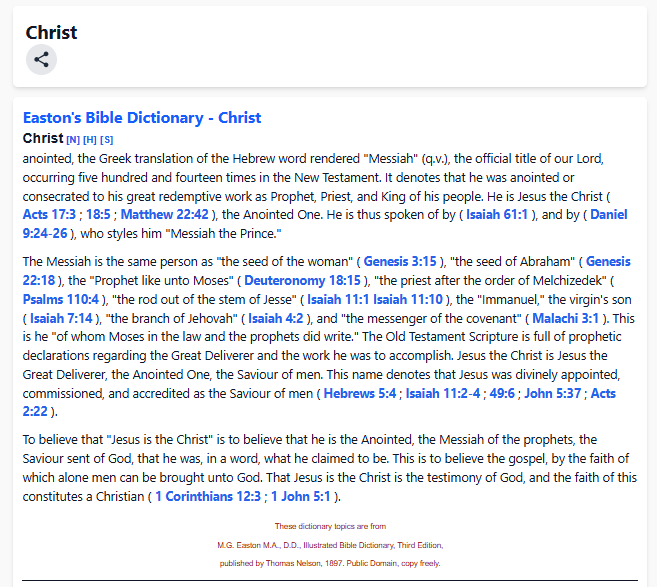
Easton’s Bible Dictionary defines Christ as the Greek translation of the Hebrew word rendered “Messiah”, meaning “anointed.” It explains that Jesus was anointed or consecrated to his work “as Prophet, Priest, and King.”
The same Christian reference work describes Jesus as “the Saviour sent of God” and states that the name denotes that he was “divinely appointed, commissioned, and accredited.” [45]
This is significant because this description comes from a traditional Christian Bible dictionary rather than from an argument introduced by this investigation. The source itself presents Christ in terms of an anointed and commissioned figure, including the office of Prophet.
The title Christ, therefore, does not itself mean “God.” It means the Anointed One/Messiah. Whether Jesus is divine is a separate theological question that must be established from the evidence rather than assumed from the title.
Jesus' Response When Asked to Identify Himself as the Messiah
A third passage is particularly important because Jesus is directly confronted with the question of whether he is the Christ.
“If thou be the Christ, tell us plainly.” — John 10:24
Jesus responds:
“I told you, and ye believed not: the works that I do in my Father’s name, they bear witness of me.” — John 10:25
Jesus therefore does not introduce a different identity in response to the question. He refers back to what he has already told them and points to the works that he performs “in my Father's name.”
The wording deserves careful attention. Jesus does not say here, “I am God.” Nor does the text record him saying to these particular questioners, in those exact words, “I am the Christ.” Instead, he says “I told you” and directs them to the evidence of his works. The important point is that Jesus understands the question to concern an identity that he has already communicated. Several Christian commentators likewise understand Jesus' response as referring to his previous indications of Messiahship, while noting that John does not record a simple “I am the Christ” formula in this particular exchange. [46]
Jesus then explains why they do not believe:
“But ye believe not, because ye are not of my sheep, as I said unto you.” — John 10:26
The image of the sheep is immediately connected with recognizing the shepherd's voice and following him. The issue is therefore not merely that Jesus has failed to identify himself; the passage presents his listeners as having already been given sufficient testimony but refusing to accept it.
Most importantly for the present investigation, Jesus continues to distinguish himself from the Father. He speaks of the sheep being given to him by the Father and says:
“My Father, which gave them me, is greater than all.” — John 10:29
The passage then leads into the statement:
“I and my Father are one.” — John 10:30
That statement will be examined separately. It should not be used retrospectively to alter what Jesus has explicitly identified himself as in the preceding discussion.
What These Statements Establish for the Test
The three passages now provide an important starting point for interpreting the disputed “I am” sayings.
In John 4:25–26, the Samaritan woman speaks about the coming Messiah, and Jesus responds:
“I that speak unto thee am he.”
The identity being confirmed is therefore the Messiah she has just mentioned.
In Matthew 16:15–17, Jesus asks his disciples directly:
“But whom say ye that I am?”
Peter answers:
“Thou art the Christ, the Son of the living God.”
Jesus does not reject the identification. Instead, he affirms the Father's revelation behind it.
In John 10:24–26, Jesus is asked directly whether he is the Christ and responds that he has already told them, pointing to his works as evidence. Christian commentators themselves recognize that Jesus' response refers back to his previous testimony concerning his Messianic identity. [47]
These passages therefore establish an important textual baseline before we approach John 8:58.
Jesus is not first encountered in the Gospel narratives as someone whose identity has to be reconstructed from the phrase “I am.” The narratives already give explicit statements concerning who he is: the Christ, the Messiah—the anointed and commissioned figure whom God has sent.
This does not, by itself, settle every question concerning Jesus' nature. It establishes something narrower and more important for the present investigation: when Jesus is directly asked about his identity, the Gospel narratives provide an explicit answer.
The disputed “I am” statements must therefore be interpreted alongside these explicit identifications, rather than allowing an interpretation of a disputed expression to erase or override the clearer statements elsewhere.
Examining the “I Am” Sayings
The previous sections established the baseline by examining Jesus’ own statements concerning his identity, mission, authority and relationship with God. We can now examine the principal passages that Christians cite as evidence that Jesus claimed divinity.
The disputed “I am” passages include:
- John 8:24 — “If ye believe not that I am he, ye shall die in your sins.”
- John 8:28 — “Then shall ye know that I am he.”
- John 8:58 — “Before Abraham was, I am.”
Each passage will now be examined on its own merit. For each one, we will first state the Christian claim, then ask whether that interpretation passes the test established above, followed by the proper context and the evidence supporting the conclusion.
The objective is not to impose an interpretation upon the text, but to determine whether the claim that these statements constitute declarations of divinity is actually supported by the evidence when the passages are read in their proper context and measured against Jesus’ own explicit testimony concerning who he was.
John 8:24 — “I Am He”
“For if ye believe not that I am he, ye shall die in your sins.” — John 8:24
The Christian Claim
Some Christians interpret “I am he” as a declaration of Jesus' divine identity and connect it with God's “I AM” in Exodus 3:14.
Does It Pass the Test?
No.
The words “I am he” do not, by themselves, identify Jesus as God. The surrounding context must establish what Jesus is identifying himself as. Nothing in John 8:24 explicitly says, “I am God,” nor does Jesus refer his statement to Exodus 3:14.
More importantly, we have already established from Jesus' explicit statements that he identifies himself as the Christ/Messiah, the one sent by the Father, whose teaching and authority come from the Father.
The Proper Context
The expression is better understood as “I am he” — the one Jesus has been speaking about in this discussion. The subject of the passage is Jesus' identity and mission, not a declaration that he is the God of Israel.
This becomes particularly clear when the same expression is examined elsewhere in John's Gospel. In John 4:25–26, the Samaritan woman speaks about the coming Messiah and Jesus answers:
“I that speak unto thee am he.”
There is no ambiguity about what “he” refers to: the Messiah.
The same identifying expression therefore cannot automatically be assigned a divine meaning every time it appears. The context determines the referent.
Evidence
The strongest evidence against automatically equating John 8:24 with Exodus 3:14 is that Jesus repeatedly distinguishes himself from the God who sent him. He says:
“My doctrine is not mine, but his that sent me.” — John 7:16
and:
“I can of mine own self do nothing.” — John 5:30
The passage must therefore be interpreted alongside these explicit statements rather than in isolation.
Conclusion: John 8:24 does not explicitly state that Jesus is God. The phrase “I am he” can function as an identification of the person Jesus claims to be—the Messiah whom God sent. The Christian identification of this expression with God's “I AM” requires an additional interpretive step that the verse itself does not explicitly make.
John 8:28 — “Then Shall Ye Know That I Am He”
“When ye have lifted up the Son of man, then shall ye know that I am he.” — John 8:28
The Christian Claim
Some Christians interpret “I am he” here as another declaration of Jesus' divine identity, connecting it with God's “I AM” in Exodus 3:14.
Does It Pass the Test?
No.
The verse does not say “I am God”, nor does Jesus identify his statement with Exodus 3:14. The words must be understood according to what Jesus is discussing and according to how he identifies himself elsewhere.
The Proper Context
The key to the statement is found in the words immediately preceding it. Jesus is speaking about “the Son of man” and about his being “lifted up.” He then says that they will know “I am he.”
The natural question is therefore: “He” who?
The answer is supplied by the subject Jesus has already introduced: the Son of man whom God has sent and who is carrying out the mission given to him.
This is especially important because Jesus immediately continues:
“I do nothing of myself; but as my Father hath taught me, I speak these things.” — John 8:28
That statement directly follows the disputed expression and explains Jesus' relationship to the Father. He does not describe himself as acting independently as God. He says that he does what the Father has taught him.
He continues:
“And he that sent me is with me: the Father hath not left me alone; for I do always those things that please him.” — John 8:29
The context therefore presents Jesus as the one sent by the Father, acting according to the Father's teaching and seeking to please the Father.
Evidence
The immediate context itself provides the interpretive key. Jesus identifies himself as the Son of Man, says that he was sent by the Father, and explicitly states that he does nothing of himself.
The phrase “I am he” therefore does not require the meaning “I am God.” It can naturally function as an identification of the person Jesus is claiming to be—the one sent by God and identified in the passage as the Son of Man.
Conclusion: John 8:28 does not establish a claim to divine identity. Its surrounding context points toward Jesus identifying himself in relation to his God-given mission, while his own words immediately distinguish him from the Father who sent and taught him.
John 8:58 — “Before Abraham Was, I Am”
“Verily, verily, I say unto you, Before Abraham was, I am.” — John 8:58
The Christian Claim
Christians commonly understand this as Jesus claiming that he personally existed before Abraham. Many go further and connect “I am” with God's words in Exodus 3:14, concluding that Jesus was identifying himself as the eternal God.
Does It Pass the Test?
No—not on the wording of the statement alone.
The verse says “I am,” but Jesus does not say “I am God,” nor does he say that he is the God who spoke to Moses in Exodus 3:14.
The connection between Jesus' words and God's declaration in Exodus is therefore an interpretation, not something Jesus explicitly states.
That interpretation must also be measured against the baseline already established: Jesus identifies himself as the Christ/Messiah, says that he was sent by the Father, says his teaching is not his own, says he can do nothing of himself, and identifies the Father as the one true God.
The Proper Context
There is another biblical concept that must be considered before assuming that “before Abraham” means that Jesus physically existed before Abraham.
God tells Jeremiah:
“Before I formed thee in the belly I knew thee; and before thou camest forth out of the womb I sanctified thee, and I ordained thee a prophet unto the nations.” — Jeremiah 1:5
Jeremiah obviously did not physically exist as a human being before his birth. Yet God says that he knew, sanctified and ordained him before he was born.
The passage therefore establishes a biblical category in which a person's calling and appointed role exist in God's knowledge and decree before that person's physical existence.
Jesus repeatedly describes himself in precisely this kind of commissioned relationship with God. He was sent by the Father, given a mission, given commandments and given the words he was to speak.
Consequently, John 8:58 can be examined within the same framework: before Abraham existed, the Messiah and the mission Jesus came to fulfil could already have been known and ordained within God's purpose. Jesus would then be speaking about the precedence of God's appointed purpose rather than claiming that he had physically lived before Abraham.
This reading does not require us to invent a new biblical concept. It uses a concept already found in the Scriptures: God's knowledge and appointment of a person and his mission precede that person's birth.
Evidence
There is also an important evidentiary problem with the claim of Jesus' literal personal existence before Abraham. Outside the later Gospel material, there is no independent historical evidence demonstrating that Jesus physically existed before Abraham. Abraham belongs to the much earlier patriarchal period, while Jesus is presented as a human being born centuries later.
The claim of literal pre-existence therefore cannot be established simply by saying:
“Jesus said ‘I am,’ and God also said ‘I AM.’”
Identical words do not establish identical identity. The connection must be demonstrated from the context.
John 8:58 may therefore be interpreted as a statement concerning Jesus' pre-eminence in God's purpose and appointment, consistent with the biblical pattern illustrated by Jeremiah 1:5. Whether that was John's intended meaning, or the precise historical wording Jesus originally used, remains a separate question.
Conclusion: What Do the “I Am” Statements Actually Establish?
The “I am” statements in John are statements of identity, but the crucial question is which identity Jesus is claiming. Christians commonly associate these statements with God's declaration in Exodus 3:14 and consequently interpret them as Jesus identifying himself as God. That conclusion, however, is not stated by Jesus in these passages. It is an interpretation imposed upon his words.
When the “I am” statements are read alongside Jesus' explicit identification of himself, a different picture emerges. Jesus identifies himself as the Messiah, the Christ, both when speaking to the Samaritan woman and when his disciples identify him as the Christ. When asked whether he is the Christ, he again points to what he has already told them and to the works performed in his Father's name.
This is consistent with the wider testimony of all four Gospels. Jesus is repeatedly presented as the one sent by God to carry out God's work. He says that his teaching is not his own, that he can do nothing by himself, that he does not seek his own will but the will of the Father, and that the words he speaks and the authority he exercises come from the Father.
The evidence therefore does not support taking Jesus' statements of “I am” and automatically transferring God's identity to Jesus. The two uses cannot be merged merely because the same words occur. Jesus tells us who he is; God tells us who He is. The Gospel evidence presents those identities and roles distinctly. To reinterpret Jesus' “I am” statements as declarations that he is the God of Israel requires an additional theological interpretation that Jesus himself does not explicitly make.
Accordingly, the claim that the “I am” sayings prove that Jesus identified himself as God is not established by the text itself. When those sayings are read in their proper context and measured against Jesus' explicit testimony concerning his own identity, mission, authority and relationship with God, the evidence points instead to Jesus identifying himself within the role he repeatedly describes: the Christ, the Messiah, the one sent by God to fulfil the mission given to him.
Summary of the Four Gospels
Our examination of the four Gospels has established that they are four ancient Christian literary works that preserve traditions and narratives concerning the life, teachings, death and reported resurrection of Jesus. What survives today, however, is not an original manuscript written by Jesus' disciples, nor a complete Gospel manuscript from the first century. The earliest physical witnesses are later manuscript fragments and copies, with the major surviving codices appearing centuries after the period in which Jesus lived.
The texts themselves do not identify their authors as Matthew, Mark, Luke and John. Those names belong to the traditional attribution of the four works. Mark is generally regarded as the earliest Gospel, yet Mark is not presented in the text as one of Jesus' twelve disciples. Matthew and Luke subsequently produced works that make extensive use of Mark while also incorporating additional material. This means that the traditional picture of four independent authors independently recording what they personally witnessed cannot simply be assumed from the titles attached to the books.
Luke's own opening also indicates that traditions concerning Jesus had already been circulating before his work was composed. The Gospel therefore represents a stage in a longer process of collecting, arranging and presenting traditions concerning Jesus. Matthew and Luke's additional material demonstrates that their sources were not limited to Mark, but the precise origins of all that additional material cannot be established with certainty. Some proposed sources, such as Q, remain scholarly reconstructions rather than surviving documents.
John presents an even more pronounced difference. Its language, structure, chronology and presentation of Jesus differ considerably from those of Matthew, Mark and Luke. Within John, Jesus is repeatedly portrayed as one sent by the Father and carrying out the Father's work, while other passages present Jesus in a much more exalted theological manner. The interpretation of passages such as “I am” and “Before Abraham was, I am” therefore cannot responsibly be separated from the rest of the evidence concerning Jesus' identity, mission and relationship with God.
This is particularly important because we cannot independently establish that every sentence placed on Jesus' lips in the Gospels was spoken by him exactly as it appears. The Gospel writers were writing decades after the events they describe, in Greek, and the original manuscripts of their works have not survived. What we possess is a later manuscript tradition containing copies of the texts. Consequently, there are several distinct stages that must not be confused: the historical Jesus, the traditions transmitted about him, the Gospel authors who selected and presented those traditions, and the later manuscripts through which their writings have survived.
The result is that the four Gospels are extremely important historical sources, but they must be treated as sources to be investigated rather than as automatically authoritative transcripts of Jesus' own words. A statement appearing in a Gospel establishes that the Gospel writer presented Jesus as saying it. It does not, by itself, establish that Jesus actually uttered those exact words.
The same principle applies to the theological conclusions subsequently drawn from those statements. Where Jesus explicitly identifies himself as the Christ or Messiah, and where the Gospel traditions repeatedly portray him as sent by God, speaking the Father's teaching, doing the Father's will and carrying out the work given to him, those passages provide the clearest material for establishing how Jesus is portrayed. More ambiguous statements should then be examined against that broader evidence rather than isolated and given a predetermined interpretation.
Therefore, the four Gospels should be understood as later written presentations of traditions about Jesus, preserved through a subsequent manuscript tradition. They give us valuable evidence about the beliefs, traditions and theological interpretations circulating within early Christianity, as well as important material for investigating the historical Jesus. But they do not give us four surviving, independent, first-hand transcripts of Jesus' life and speech.
That distinction provides the necessary foundation for everything that follows: what the Gospel texts actually say, what the authors appear to have intended, what traditions may stand behind their accounts, what can be historically established about Jesus himself, and what theological conclusions are being drawn beyond the evidence of the texts.