
Major Themes
The Qur'an’s Central Theological Vision
The Qur'an addresses a wide range of subjects, but its individual teachings are connected by a coherent theological and moral vision. At the centre is the affirmation of the absolute oneness of Allah, together with the claim that He alone is the Creator, Sustainer, and rightful object of worship. From this central principle follow the Qur'an's teachings concerning revelation, prophethood, human responsibility, worship, morality, justice, and the final judgement. Modern academic studies of the Qur'an likewise identify the oneness of Allah as one of its most important recurring themes, alongside prophecy, revelation, the afterlife, ethical conduct, and social responsibility.[1]
The Qur'an repeatedly directs human beings to recognise Allah through His creation and through the signs present in the natural world and within human existence. Creation is presented not merely as a physical environment but as evidence of divine power, wisdom and providence. The alternation of night and day, rainfall, vegetation, the diversity of living beings, human creation and the ordered structure of the heavens are among the phenomena that the Qur'an describes as signs (āyāt) inviting reflection.
“Indeed, in the creation of the heavens and the earth and the alternation of the night and day are signs for those of understanding.”
Qur'an 3:190
The Qur'anic concept of āyah is therefore broader than a reference to a written verse. The same term can denote a Qur'anic sign or verse and, in other contexts, a sign within creation. This relationship between revelation and creation is significant to the Qur'an's overall worldview: the created order is presented as pointing beyond itself to its Creator, while revelation provides guidance concerning how human beings should understand and respond to that reality.[2]
Tawhid and Knowledge of Allah
The most pervasive theological theme of the Qur'an is tawḥīd, the affirmation that Allah is one and without associate. The Qur'an rejects the attribution of divine status to other beings and repeatedly contrasts belief in one Creator with polytheistic conceptions of divinity. Allah is described through names and attributes expressing His knowledge, power, mercy, wisdom, justice and sovereignty.
“Say, ‘He is Allah, One. Allah, the Eternal Refuge. He neither begets nor is born, nor is there to Him any equivalent.’”
Qur'an 112:1–4
The doctrine of divine unity is not presented as an abstract philosophical proposition alone. It has practical consequences for worship and human conduct. Because Allah is presented as the sole Creator and sovereign, worship, ultimate obedience, reliance and moral accountability are directed toward Him. The Qur'an therefore connects belief with action rather than treating faith as merely intellectual assent.[3]
The Qur'an also repeatedly challenges human beings to examine the basis of their beliefs. It asks questions concerning the origin of creation, the existence of multiple supposed deities, and the dependence of created beings upon a higher Creator. Such passages function as theological arguments as well as exhortations to reflection. The Qur'anic presentation of faith consequently combines revelation with repeated appeals to reason, observation, memory and reflection.
Revelation and Divine Guidance
Another fundamental theme is revelation. The Qur'an presents itself as divine guidance communicated to humanity through a succession of messengers. Revelation is not portrayed as an isolated event restricted to one community but as part of a longer history in which Allah repeatedly sent guidance when human beings deviated from the message delivered by earlier prophets.
“Indeed, We have revealed to you, as We revealed to Nuh and the prophets after him, and We revealed to Ibrahim, Ismail, Ishaq, Ya'qub and the Descendants, and Isa, Ayyub, Yunus, Harun and Sulayman, and to Dawud We gave the Zabur.”
Qur'an 4:163
The Qur'an thus places Muhammad ﷺ within a broader prophetic history. The central message of the prophets is presented as continuous in its fundamental call to worship Allah and live according to His guidance, while particular laws and practices could differ between communities.
“And We revealed to you the Book in truth, confirming what was before it of the Scripture and as a criterion over it.”
Qur'an 5:48
The Qur'an also describes itself using several concepts associated with guidance, including hudā (guidance), dhikr (reminder), furqān (criterion) and tadhkirah (reminder or admonition). These descriptions indicate that the Qur'an understands its function not simply as conveying information but as calling human beings to recognise truth, remember their accountability and alter their conduct accordingly.[4]
Prophethood and Human Guidance
Closely connected with revelation is the Qur'anic theme of prophethood. The Qur'an names numerous prophets and messengers and presents their experiences as part of a continuous history of divine guidance. Nuh (Noah) (Nūḥ) عليه السلام, Ibrahim (Abraham) (Ibrāhīm) عليه السلام, Musa (Moses) (Mūsā) عليه السلام, Isa (Jesus) (ʿĪsā) عليه السلام and Muhammad ﷺ are among the figures whose missions receive substantial attention.
The Qur'an presents the prophets as human beings chosen to communicate Allah's message. They are not depicted as independent sources of divinity but as servants and messengers whose authority derives from the revelation entrusted to them. Their histories illustrate recurring Qur'anic themes: the proclamation of divine unity, rejection by sections of their communities, perseverance in delivering the message, and eventual judgement upon those who rejected it.
The prophetic narratives therefore serve several functions simultaneously. They communicate historical or sacred history as understood by the Qur'an, provide moral examples, establish continuity between successive revelations, and warn Muhammad's contemporaries that rejection of a messenger was not unprecedented. The stories of earlier peoples are repeatedly connected to the present moral choices of the Qur'an's audience.[5]
Human Purpose, Worship and Moral Responsibility
The Qur'an presents human existence as purposeful rather than accidental or morally directionless. Human beings are created by Allah, given capacities for understanding and choice, and held responsible for how they use those capacities. Worship consequently extends beyond ritual acts to encompass obedience, gratitude, moral conduct and conscious submission to Allah.
“I did not create jinn and mankind except to worship Me.”
Qur'an 51:56
Worship in the Qur'anic worldview includes formal practices such as prayer, fasting and pilgrimage, but the Qur'an also repeatedly connects religious devotion with honesty, generosity, patience, fulfilment of agreements, care for parents, protection of the vulnerable and justice toward others. Faith and conduct are therefore treated as interconnected dimensions of religious life.
The Qur'an frequently uses the concept of taqwā, commonly translated as God-consciousness, reverence for Allah or piety, to describe the moral awareness expected of believers. Human worth is not presented as dependent upon wealth, lineage or social status but upon faith and righteous conduct.
“Indeed, the most noble of you in the sight of Allah is the most righteous of you.”
Qur'an 49:13
This ethical dimension extends to relationships between individuals and communities. The Qur'an condemns fraud, exploitation, oppression, false testimony, arrogance and unjust consumption of wealth, while repeatedly commanding charity, fairness, compassion and the fulfilment of obligations.[6]
The Hereafter and Human Accountability
The expectation of a final judgement is another pervasive Qur'anic theme. Human life is presented as temporary, while the consequences of human choices extend beyond death. The Qur'an describes resurrection, judgement, reward and punishment in numerous passages, using vivid imagery to emphasise that actions have lasting consequences.
“So whoever does an atom's weight of good will see it, and whoever does an atom's weight of evil will see it.”
Qur'an 99:7–8
The Qur'anic doctrine of the afterlife provides the framework within which many of its ethical teachings are presented. Justice is not always fully realised within earthly life; therefore, the Qur'an places ultimate accountability beyond death. Those who believe and act righteously are promised reward, while persistent rejection and wrongdoing are associated with punishment.
The theme is not confined to descriptions of paradise and hell. The Qur'an also describes resurrection, the end of the present world, the gathering of humanity, the weighing or recording of deeds, divine judgement and the final destiny of human beings. Modern Qur'anic scholarship identifies eschatology as one of the central dimensions of the Qur'an's message, particularly its treatment of resurrection, judgement and the world to come.[7]
The relationship between tawhid and the afterlife is particularly significant. The Creator who brought humanity into existence is also presented as capable of resurrecting humanity and judging its actions. The Qur'an therefore repeatedly connects creation with resurrection, arguing that the power demonstrated in the creation of the universe and human beings establishes the possibility of their restoration after death.
The Interconnection of the Major Themes
These themes do not function as isolated subjects. Tawhid establishes the identity and sovereignty of Allah; revelation communicates His guidance; prophethood delivers that guidance to human communities; worship and morality describe the appropriate human response; and the afterlife establishes the ultimate consequences of human choices. Creation provides signs through which human beings are called to recognise Allah, while the histories of earlier peoples illustrate the consequences of accepting or rejecting divine guidance.
The Qur'an consequently develops its message through repeated movement between belief, reflection, history, moral instruction and eschatological warning. A passage concerning creation may lead to an argument for divine unity; an account of a prophet may lead to a warning about judgement; and a command concerning social conduct may be connected to accountability before Allah. The thematic unity of the Qur'an therefore lies not in restricting each passage to a single subject but in repeatedly relating different subjects to its central conception of Allah, humanity, revelation and accountability.[8]
Satan, Evil and Moral Choice
The Qur'an treats evil as a significant dimension of human existence while maintaining that Allah is the ultimate Creator and sovereign over creation. The Qur'an identifies satan as an enemy of humanity who seeks to mislead people, encourage disobedience and divert them from remembrance of Allah. His influence, however, is presented as a temptation rather than an irresistible power over human beings. Human responsibility remains central because individuals are repeatedly called upon to recognise deception, resist temptation and choose righteousness.
“Indeed, satan is an enemy to you; so take him as an enemy. He only invites his party to be among the companions of the Blaze.”
Qur'an 35:6
The Qur'an also describes human beings as possessing moral choice and being accountable for their decisions. Evil is therefore connected not only with satanic temptation but also with human arrogance, injustice, greed, violence, rejection of truth and the misuse of freedom. The Qur'an's treatment of evil consequently combines theological, moral and psychological dimensions.[9]
The concept of satan is also connected with the Qur'anic emphasis on remembrance of Allah. Forgetfulness, heedlessness and following desire are repeatedly associated with moral failure, while remembrance, reflection and obedience provide means of resisting deviation. The Qur'an does not present human beings as helpless victims of an external force; rather, it repeatedly places moral responsibility upon the individual.
Mercy, Forgiveness and Repentance
Divine mercy is one of the most frequently recurring characteristics associated with Allah in the Qur'an. The opening of the Qur'an begins with the invocation of Allah as al-Raḥmān and al-Raḥīm, commonly translated as “the Most Compassionate” and “the Most Merciful.” These attributes establish mercy at the beginning of the Qur'anic text and recur throughout its teachings.
“Say, ‘O My servants who have transgressed against themselves, do not despair of the mercy of Allah. Indeed, Allah forgives all sins. Indeed, it is He who is the Forgiving, the Merciful.’”
Qur'an 39:53
Mercy in the Qur'an is not presented as an alternative to justice. Rather, divine mercy, forgiveness and judgement appear together. Human beings are warned about the consequences of wrongdoing, while simultaneously being repeatedly invited to repent and return to Allah. Repentance (tawbah) therefore constitutes an important Qur'anic response to moral failure.
The Qur'an also connects divine forgiveness with human conduct. Those who seek forgiveness are expected to abandon wrongdoing, while believers are instructed to extend forgiveness and restraint toward others. Mercy thus has both a theological dimension, concerning Allah's relationship with humanity, and an ethical dimension, concerning relationships between human beings.[10]
Justice and Social Responsibility
Justice is another major Qur'anic theme. The Qur'an commands believers to establish justice even when doing so conflicts with their own interests or those of people close to them.
“O you who believe, be persistently standing firm in justice, witnesses for Allah, even if it be against yourselves or parents and relatives.”
Qur'an 4:135
The command to act justly is not restricted to dealings between Muslims. The Qur'an instructs believers not to allow hostility toward another people to cause them to abandon justice.
“And do not let the hatred of a people prevent you from being just. Be just; that is nearer to righteousness.”
Qur'an 5:8
Justice therefore functions as a moral principle extending beyond personal preference, tribal loyalty or communal interest. Qur'anic ethical teaching repeatedly addresses the treatment of orphans, the poor, debtors, dependants, spouses, relatives and commercial partners. It also condemns fraud in weights and measures, unlawful consumption of wealth and exploitation of vulnerable people.[11]
The Qur'anic emphasis on social responsibility means that religious devotion cannot be separated entirely from social conduct. Acts of worship are repeatedly accompanied by commands concerning charity, justice and assistance to those in need. The ethical dimension of the Qur'an has consequently been a major subject of Islamic ethical thought as well as modern academic study of Qur'anic morality.[12]
Family, Community and Human Relationships
The Qur'an devotes substantial attention to human relationships, beginning with the family and extending to wider society. Marriage is presented as a relationship characterised by tranquillity, affection and mercy, while parents are accorded particular respect.
“And among His signs is that He created for you from yourselves mates that you may find tranquillity in them; and He placed between you affection and mercy.”
Qur'an 30:21
The Qur'an also commands kindness toward parents and establishes obligations concerning children, spouses, relatives, orphans and the economically vulnerable. Its social teaching includes rules concerning marriage, divorce, inheritance, financial transactions and family responsibilities. These provisions form part of the Qur'an's broader concern with ordering human relationships according to justice and responsibility.
Beyond the family, the Qur'an describes humanity as composed of peoples and tribes and rejects the idea that social distinctions themselves establish superiority.
“O mankind, indeed We have created you from male and female and made you peoples and tribes that you may know one another. Indeed, the most noble of you in the sight of Allah is the most righteous of you.”
Qur'an 49:13
The verse places human diversity within a moral framework. Differences of lineage, people and social identity are acknowledged, but ultimate human distinction before Allah is associated with righteousness rather than ancestry. The Qur'an therefore addresses both individual morality and the structure of communal relationships.
Wealth, Charity and Economic Conduct
Economic behaviour is another recurring concern. Wealth is recognised as a legitimate part of human life, but the Qur'an repeatedly warns against allowing material possessions to become an object of greed or a source of social oppression. Wealth carries responsibilities toward others, particularly the poor and vulnerable.
The Qur'an commands charity and repeatedly praises those who spend from what Allah has provided for them. Zakāh became a formal obligation within Islamic practice, while voluntary charity (ṣadaqah) is also strongly encouraged.
“Establish prayer and give zakah, and whatever good you put forward for yourselves—you will find it with Allah.”
Qur'an 2:110
The Qur'an also regulates commercial conduct. Honest measurement, fulfilment of contracts, proper documentation of debts and prohibition of unjust financial practices are among the subjects addressed. The prohibition of ribā, traditionally understood as usurious or interest-based gain within the relevant Qur'anic legal framework, is presented alongside commands concerning charity and fair dealing.
These teachings reflect a broader Qur'anic principle: economic activity is not morally neutral when it involves exploitation, deception or unjust enrichment. Material wealth is treated as something for which human beings are accountable, rather than as an unrestricted measure of personal worth.
Knowledge, Reflection and the Use of Reason
The Qur'an frequently calls upon human beings to think, observe, remember, understand and reflect. Expressions such as “will you not reason,” “will they not reflect,” and “for those who understand” recur throughout the text. Knowledge is consequently an important Qur'anic theme, although the Qur'an does not reduce knowledge to one particular intellectual discipline.
The Qur'an directs attention toward revelation, history, human nature and the created world. It encourages people to examine what happened to earlier communities, consider the signs present in creation and reflect upon their own existence.
“Do they not reflect within themselves? Allah did not create the heavens and the earth and what is between them except in truth and for a specified term.”
Qur'an 30:8
This emphasis does not mean that the Qur'an presents empirical science in the modern sense. Rather, it repeatedly encourages observation and reflection as means through which human beings may recognise signs of Allah's power and reconsider their assumptions about existence. The relationship between reason, revelation and knowledge has consequently become an important subject in both classical Islamic thought and modern Qur'anic studies.[13]
Freedom of Religion and Relations with Other Communities
The Qur'an addresses religious diversity and the existence of communities that do not accept Muhammad's ﷺ message. It recognises Jews and Christians as the People of the Book and engages extensively with their scriptures, beliefs and historical traditions. At the same time, it criticises particular theological claims and religious practices that it regards as erroneous.
The Qur'an also contains an explicit statement concerning religious compulsion:
“There shall be no compulsion in religion.”
Qur'an 2:256
Other passages regulate relations between Muslims and non-Muslim communities in different circumstances, including peaceful relations, religious disagreement, political conflict and warfare. These passages need to be understood in their respective textual and historical contexts rather than reduced to a single undifferentiated rule concerning all relations with non-Muslims.
The Qur'an's treatment of religious communities therefore contains several dimensions: theological disagreement, recognition of earlier revelation, ethical relations, communal boundaries and rules governing conflict. This complexity is an important feature of the text and has generated extensive interpretation in both classical Islamic scholarship and modern academic studies.[14]
Patience, Gratitude and Trust in Allah
Patience (ṣabr) and gratitude (shukr) are recurring virtues in the Qur'an. Human beings are expected to respond appropriately both to difficulty and to prosperity. Patience is associated with perseverance in obedience, endurance during hardship and restraint in the face of provocation, while gratitude involves recognising Allah's blessings and responding through obedience and righteous action.
“Indeed, Allah is with the patient.”
Qur'an 8:46
The Qur'an also repeatedly links gratitude with the recognition of divine provision.
“If you are grateful, I will surely increase you [in favour].”
Qur'an 14:7
Gratitude is therefore more than an emotional response. It is connected with how a person uses the blessings received. Contemporary academic studies of Qur'anic ethics similarly identify gratitude as a concept that extends from the individual's relationship with Allah into relationships with other people and into patterns of ethical behaviour.[15]
Hope, Fear and Spiritual Balance
The Qur'an frequently combines warning with hope. Its descriptions of judgement and punishment are accompanied by promises of forgiveness, mercy and reward. This combination prevents the Qur'anic moral framework from being reduced either to fear of punishment or to expectation of unconditional reward.
Believers are repeatedly encouraged to hope in Allah while remaining conscious of their accountability. The Qur'an warns against despair of divine mercy while also warning against assuming that wrongdoing carries no consequences. This balance between hope and fear is reflected in Islamic theological and spiritual traditions and is rooted in the Qur'an's simultaneous emphasis on Allah's mercy, justice and judgement.
The Qur'an's Integrated Moral and Theological Framework
The major themes of the Qur'an ultimately converge upon a single integrated conception of human existence. Allah is presented as the Creator and sovereign; humanity is created with purpose and entrusted with moral responsibility; revelation provides guidance; prophets communicate that guidance; satan seeks to mislead; human beings are capable of choosing between obedience and disobedience; society is expected to be governed by justice and responsibility; and death does not terminate accountability because humanity will be resurrected and judged.
This thematic integration is one reason scholars have approached the Qur'an not merely as a collection of individual legal, theological or narrative passages but as a text possessing recurring concepts and interconnected concerns. Fazlur Rahman's influential study, for example, organises its examination around God, the individual, society, nature, prophethood and revelation, eschatology, satan and evil, and the emergence of the Muslim community.[16] Daniel A. Madigan's contribution to The Cambridge Companion to the Qur'an similarly treats the identification and analysis of themes as a distinct field within Qur'anic studies.[17]
The Qur'an's themes therefore cannot be fully understood by examining individual verses in isolation. Its theological claims, ethical instructions, narratives, descriptions of creation and warnings concerning the afterlife repeatedly illuminate one another. The resulting worldview presents human life as a period of moral testing within a created order that points toward Allah, guided by revelation and ultimately directed toward accountability before Him.
Scientific Signs
The Qur'an as a Continuing Miracle
The Qur'an as a Continuing Miracle
Throughout the history of revelation, Allah granted His messengers signs by which their communities could recognise that they had been sent by Him. When a messenger came with a claim that could not be established merely by ordinary human ability, Allah could support him with a sign beyond the capacity of those around him. Musa (Moses) (Mūsā) عليه السلام was given signs before Pharaoh, including the transformation of his staff and the shining of his hand. Isa (Jesus) (ʿĪsā) عليه السلام was given extraordinary signs, including healing the blind and the leper and bringing the dead to life, all by Allah's permission.
“And you heal the blind and the leper by My permission; and when you brought forth the dead by My permission.”
Qur'an 5:110
These signs served a clear purpose. A messenger claimed to speak on behalf of Allah, while the miracle provided his contemporaries with something beyond ordinary human ability. The Qur'an repeatedly emphasises that such miracles were performed by Allah's permission. The messenger was not the source of the supernatural power; Allah was.
With Muhammad ﷺ, the nature of the enduring sign took a remarkable form. The Prophet ﷺ was himself granted numerous miracles, including those recorded in authentic Hadith, but the Qur'an occupies a unique position because the revelation itself is presented as a continuing miracle. It was not a sign witnessed only by one generation and then preserved through testimony. The revelation remained with the community, recited by its members, memorised by successive generations and available for examination by anyone who encountered it.
The Qur'an draws attention to this very point:
“Is it not sufficient for them that We have sent down to you the Book which is recited to them? Surely in this is a mercy and a reminder for a people who believe.”
Qur'an 29:51
The miracle, in this sense, is present in the Book itself.
This was especially significant because Muhammad ﷺ was not known as the author of a literary or scholarly work. The Qur'an describes him as al-nabī al-ummī, the unlettered prophet:
“Those who follow the Messenger, the unlettered prophet, whom they find written in what they have of the Torah and the Gospel...”
Qur'an 7:157
The Qur'an further states:
“You did not recite any Scripture before it, nor did you write one with your right hand. Otherwise, the people of falsehood would have had reason to doubt.”
Qur'an 29:48
In the traditional Islamic understanding, this circumstance is central to the miracle of the Qur'an. Muhammad ﷺ was not presenting a book that he had written after years of studying the scriptures and intellectual traditions of the ancient world. He was receiving revelation and reciting it to others. The Qur'an itself points to the absence of a prior literary authorship as part of the evidence surrounding its revelation. Classical Muslim exegetes consequently treated the Prophet's being ummī as closely connected with the divine origin of the Qur'an.[18]
The revelation that emerged through this unlettered prophet was unlike anything his society had encountered. It spoke in a form that was neither conventional poetry nor ordinary prose, yet possessed a powerful rhythm, sound, structure and rhetorical force. Its verses could be concise while carrying layers of meaning; a warning could become a theological argument, a historical account could become a moral lesson, and a description of creation could become an invitation to contemplate Allah.
The Qur'an itself presents this extraordinary nature as a challenge.
“Say, ‘If mankind and jinn were to come together to produce the like of this Qur'an, they could not produce its like, even if they were to each other assistants.’”
Qur'an 17:88
The challenge is progressively expressed in the Qur'an, including the challenge to produce ten chapters like it and ultimately even a single surah. The challenge is therefore not simply an invitation to admire the Qur'an. It is presented as a test of its claimed human authorship. If Muhammad ﷺ had composed the Qur'an himself, the argument runs, then those who rejected his message should have been capable of producing something comparable.[19]
This became particularly significant in seventh-century Arabia, where mastery of Arabic expression, poetry and eloquence held an important place in culture. The Qur'an entered that environment not as an ordinary literary composition but as a form of Arabic revelation that challenged its hearers at the level of language itself. The later Islamic discipline of iʿjāz al-Qurʾān, the doctrine of the Qur'an's miraculous inimitability, developed around this Qur'anic claim and became one of the major subjects of classical Islamic scholarship.[20]
The beauty of the Qur'an is therefore not merely ornamental. Its sound, rhythm and rhetorical structure carry its meaning. When recited in Arabic, the movement of its words, the cadence of its verses and the changes in rhythm can reinforce the emotional and intellectual force of what is being said. A passage describing divine mercy can possess a different cadence from one warning of judgement; a narrative can move rapidly through events; a short verse can leave an argument suspended in the mind of the listener.
This dimension of the Qur'an is especially difficult to reproduce in translation because translation necessarily replaces the Arabic words, sounds and grammatical structures with another language. The meaning can be communicated, but the complete literary experience of the Arabic revelation cannot simply be transferred word for word. The detailed subject of Qur'anic reading, recitation, pronunciation and its aesthetic dimensions will be examined later in the section devoted specifically to reading and recitation.
The Qur'an's miracle, however, is not confined to its language.
It speaks about Allah, humanity, history, morality, the unseen world, death and resurrection. It recounts the lives of earlier prophets and nations. It speaks about creation and the heavens. It describes human development, the natural world, the seas and the earth. It refers to realities that human beings can observe and others that cannot be seen directly. Its message repeatedly moves from what can be seen to what lies beyond the visible world.
This is where the Qur'an's signs in creation become particularly remarkable.
Signs in the Horizons and Within Humanity
The Qur'an repeatedly calls upon human beings to look beyond themselves and contemplate the universe in which they live.
“Indeed, in the creation of the heavens and the earth and the alternation of night and day are signs for those of understanding.”
Qur'an 3:190
The word āyah, whose plural is āyāt, carries the meaning of a sign, indication or evidence. It is also the word used for the individual verses of the Qur'an. The relationship is significant: the Qur'an contains revealed āyāt, while creation itself contains āyāt. Both direct attention beyond themselves.
The Qur'an makes this relationship explicit:
“We will show them Our signs in the horizons and within themselves until it becomes clear to them that it is the truth.”
Qur'an 41:53
The verse presents the horizons and human beings themselves as places in which Allah's signs will become increasingly apparent. The universe is not portrayed as a collection of meaningless objects. Its order, origin and processes are repeatedly presented as signs pointing toward its Creator.
For the first hearers of the Qur'an, much of the universe remained beyond the reach of detailed observation. The naked eye could see the sun, moon and stars, but not galaxies, stellar evolution, microscopic structures, oceanographic boundaries, embryonic development or the physical composition of distant celestial bodies. Human beings could observe pregnancy, rainfall, rivers and seas, but could not observe the processes taking place within an embryo or measure the complex physical properties of water masses.
More than fourteen centuries later, scientific instruments have opened dimensions of creation that were previously invisible. Telescopes have transformed humanity's understanding of the universe. Microscopes and medical imaging have revealed structures within living organisms. Oceanographic instruments can measure salinity, temperature and density across enormous bodies of water. Geological research has uncovered the history of the earth and the formation of its elements. Modern science has therefore provided humanity with an extraordinary ability to examine the very realms toward which the Qur'an repeatedly directs attention.
It is within this expanding field of human knowledge that some Qur'anic passages acquire a remarkable significance.
The Qur'an does not describe itself as a book of scientific formulas. Its purpose is far greater. Yet among its signs are statements concerning the created world that invite comparison with realities that modern science has only recently been able to observe in detail.
One such example concerns the origin of the universe.
Another concerns the expansion of the heavens.
Another concerns the meeting of different bodies of water and the boundary between them.
The Qur'an also speaks of the stages through which the human being develops before birth, of the origin and significance of iron, and of the preservation of Pharaoh's body. These passages belong to very different subjects, yet they share a remarkable feature: they direct attention toward realities that extend beyond ordinary surface observation.
The significance of these passages lies not in turning the Qur'an into a science textbook. Their significance lies in the question that arises when the text is placed beside the history of human knowledge: how could Muhammad ﷺ, living in seventh-century Arabia and described by the Qur'an as an unlettered prophet, have possessed knowledge concerning realities that would only become accessible to later generations through entirely different means of investigation?
For a Muslim, the answer is contained within the Qur'an itself. The knowledge did not originate with Muhammad ﷺ. It came from Allah.
The Qur'an repeatedly attributes its revelation to the One who created the very universe it describes:
“Say, ‘It has been sent down by the One Who knows every secret in the heavens and the earth. Indeed, He is ever Forgiving, Most Merciful.’”
Qur'an 25:6
The argument therefore becomes cumulative. The Prophet ﷺ brought a revelation in a language of extraordinary power and beauty, challenged humanity to produce anything comparable to it, came from a background that did not involve authorship of scripture, and delivered passages concerning creation that continue to provoke reflection as human knowledge advances.
The scientific signs examined in the following pages are therefore not isolated curiosities. They form part of the wider Qur'anic presentation of itself as a revelation from the Creator—a Book that repeatedly tells humanity to look, think, remember and recognise the signs of Allah.
Among the many examples, the first to be examined is one that can now be observed with remarkable clarity through modern oceanography: the meeting of fresh and salt water and the boundary that exists between them.
The Barrier Between Fresh and Salt Water
The Qur'an describes two bodies of water meeting while a barzakh—a barrier, partition or separating boundary—exists between them:
“And He is the One Who has released the two seas, one fresh and sweet and the other salty and bitter, and He has made between them a barrier and a forbidden partition.”
Qur'an 25:53
A second passage presents the phenomenon in similarly striking language:
“He released the two seas, meeting together; between them is a barrier, neither of them transgressing.”
Qur'an 55:19–20
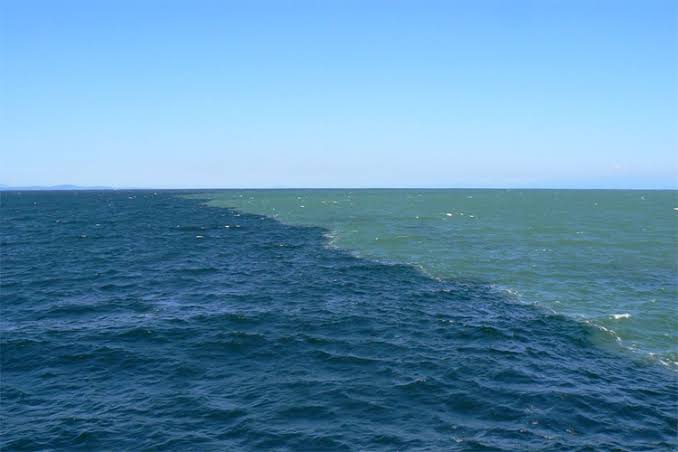
The verses describe waters that meet while a separating boundary remains between them. The Arabic term barzakh denotes a barrier, partition or intervening boundary. The Qur'an does not describe an invisible wall that prevents all physical exchange; rather, it draws attention to a boundary existing between distinct bodies of water.
Modern oceanography has revealed that when bodies of water with different salinity, temperature and density meet, their physical characteristics can remain distinguishable across transition zones. Estuaries, river mouths and oceanic boundaries provide examples in which freshwater and seawater interact while maintaining measurable differences in their physical properties. Modern instruments can measure these gradients in ways that were impossible for the people of the seventh century.
The phenomenon is particularly striking when viewed from above. Satellite imagery can reveal different bodies of water meeting at coastlines and river mouths, sometimes producing sharply contrasting colours caused by differences in sediment, salinity, temperature and other properties. Beneath the visible surface, instruments can detect further differences that cannot be perceived by the naked eye.
The Qur'an places this phenomenon within its larger description of Allah's control over creation. The meeting of the waters is not presented as a random curiosity but as one of the signs through which the order of the created world can be recognised.
For a modern reader, the significance of the passage becomes especially vivid when the Qur'anic description is placed beside the scientific images and measurements now available. What was once a phenomenon that could be seen only in its simplest outward form can now be investigated in detail through oceanography.
The Qur'an's words were recited more than fourteen centuries ago. Today, the meeting of different water masses can be photographed, measured and analysed, revealing boundaries and physical gradients invisible to the unaided eye.
The Origin of the Universe
Among the most striking subjects addressed by the Qur'an is the origin of the heavens and the earth. The Qur'an repeatedly directs attention to the heavens as part of Allah's creation, but one passage is particularly remarkable in describing an early state in which the heavens and the earth were joined and were then separated:
“Have those who disbelieved not considered that the heavens and the earth were a joined entity, and We separated them and made from water every living thing? Then will they not believe?”
Qur'an 21:30
The Arabic expressions ratq and fatq describe, respectively, something joined, closed or brought together and something opened, separated or divided. Classical exegetes recorded interpretations in which the heavens and earth were understood as having been joined and then separated. Ibn Kathir, for example, records reports describing them as originally joined before Allah separated them.[21]
The modern scientific picture of the universe begins from an extremely hot and dense early state and describes the subsequent expansion and development of the cosmos. Modern cosmology does not describe the universe as two solid objects—the heavens and the earth—literally joined together and then physically pulled apart. The Qur'anic verse is broader than such a mechanical description. Its remarkable feature is that it directs attention to an original state of cosmic unity followed by separation and development, at a time when the prevailing human conceptions of the universe were very different. Modern observations of the cosmic microwave background provide direct evidence concerning the early hot, dense universe and its subsequent evolution.[22]
The passage is also notable because it does not end with the heavens and earth. It immediately connects the cosmic statement with life:
“...and We made from water every living thing.”
Qur'an 21:30
Water is fundamental to life as known on Earth. The chemical and physical properties of water make it indispensable to the known biological processes upon which terrestrial life depends. The Qur'anic statement therefore brings together two immense subjects in a single verse: the origin and ordering of the cosmos and the dependence of living things upon water.
The verse does not provide a modern cosmological equation or a technical account of biological origins. Instead, it presents creation itself as evidence of Allah's power and asks the reader to reflect upon what lies behind the existence of the heavens, the earth and life.
The modern scientific understanding of cosmic history emerged only after centuries of astronomical observation, mathematical development and, eventually, observations of galaxies and the cosmic background radiation. The Qur'an's ancient audience possessed none of these instruments. Yet the text directed attention toward the heavens as a created reality with an origin and development rather than an eternally unchanging backdrop.
The Expansion of the Heavens
Another passage has attracted particular attention because of its description of the heavens in terms that can be understood as involving expansion:
“And the heaven We constructed with strength, and indeed, We are its expander.”
Qur'an 51:47
The Arabic expression innā la-mūsiʿūn has been interpreted in different ways by Muslim exegetes and translators. It derives from a root associated with spaciousness, capacity and expansion. Ibn Kathir, for example, understood the expression in the sense of Allah having made the heavens vast and extended.[23] Modern translations have likewise differed, with some rendering the passage in terms of Allah's vastness or power and others explicitly referring to expansion.
The significance of the verse became particularly striking after modern astronomy established that the universe is expanding. Observations of distant galaxies demonstrated that galaxies are generally receding from one another, and the expansion of the universe became a central feature of modern cosmology. NASA describes the universe as having expanded from an extremely hot and dense early state, with the cosmic microwave background providing evidence of its early history.[24]
The Qur'an's statement was revealed more than fourteen centuries before modern cosmology developed. Its description of the heavens is therefore frequently cited in discussions of Qur'anic scientific signs. The significance lies in the fact that a Qur'anic expression concerning the vastness or expansion of the heavens can be read in striking correspondence with a fundamental feature of the modern scientific understanding of the universe.
The Universe in an Early State of “Smoke”
The Qur'an also describes an early state of the heavens using the word dukhān, ordinarily meaning smoke:
“Then He turned to the heaven when it was smoke and said to it and to the earth, ‘Come willingly or unwillingly.’ They both said, ‘We come willingly.’”
Qur'an 41:11
The verse forms part of a passage describing the creation and ordering of the heavens and earth. The Qur'an presents the heaven at this stage as dukhān. Classical tafsir therefore understood the verse as describing a stage in the formation of the heavens before their subsequent ordering.[25]
Modern cosmology describes the early universe as a hot, dense state of matter and radiation. As the universe expanded and cooled, matter developed into increasingly complex structures, eventually producing stars, galaxies and planetary systems. NASA's description of the early universe likewise presents it as an extremely hot, dense environment that subsequently cooled and developed into the structured universe observed today.[26]
The Qur'an does not provide a modern cosmological model in this passage. It gives a concise image of the heavens in an early state and places that image within an account of Allah's creative command. Yet the description of the early heavens as dukhān is striking when viewed alongside the modern understanding of the early universe as a hot, dense environment in which matter existed long before the formation of stars and galaxies.
The Darkness of the Deep Sea
The Qur'an also directs attention beneath the surface of the oceans:
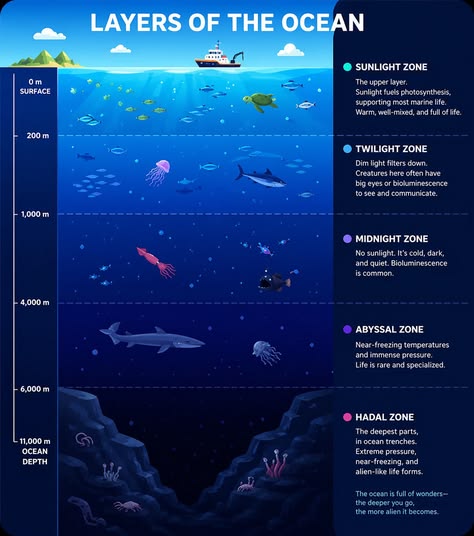
“Or like the darkness in a vast, deep sea, covered by waves, above which are waves, above which are clouds—darknesses, one above another. When one puts out his hand, he can hardly see it.”
Qur'an 24:40
The passage describes successive darknesses within a deep sea and speaks of waves above waves and clouds above them. The imagery is remarkable because ordinary human experience at the time of revelation provided no means of descending to great ocean depths and observing the conditions there directly.
Modern oceanography has established that sunlight does not penetrate the ocean indefinitely. As depth increases, light is progressively absorbed and scattered, and at sufficient depth the environment becomes effectively dark. The ocean also contains internal waves and layers of movement that are not always visible from the surface.[27]
The Qur'anic description of darknesses “one above another” is particularly evocative when considered alongside the way light diminishes through the water column.
Modern scientific research has shown that different wavelengths of light penetrate seawater to different depths, with red light disappearing relatively quickly and blue wavelengths penetrating farther. Beyond the photic zone, sunlight is insufficient for ordinary photosynthetic activity. The verse therefore presents a picture of an environment that is profoundly different from the bright surface world familiar to ordinary human beings. Modern instruments allow scientists to descend into these depths and document conditions that the naked eye cannot perceive from above.
The Layers of the Atmosphere
The Qur'an also describes the sky in terms of protection:
“And We made the sky a protected ceiling, yet they turn away from its signs.”
Qur'an 21:32
The classical Qur'anic commentators understood the “protected ceiling” primarily in theological and cosmological terms, including Allah's protection of the heavens from the forces described in the Qur'anic worldview.[28]The verse nevertheless takes on an additional significance when considered alongside modern knowledge of the atmosphere.
The atmosphere protects life on Earth in several ways. It absorbs or attenuates portions of harmful ultraviolet radiation, contributes to the regulation of surface temperature and causes many small meteoroids to burn or fragment before reaching the surface. The atmosphere therefore functions as a protective environment surrounding the earth.
The Qur'anic image of the sky as a “protected ceiling” is consequently striking when viewed from the perspective of modern science. What appears to the human observer simply as the open sky is in reality a complex atmospheric system surrounding the planet and participating in the protection and maintenance of life.
Mountains and the Earth
The Qur'an repeatedly draws attention to mountains and their relationship to the earth. One of the most frequently discussed passages states:
“And He cast into the earth firmly set mountains, lest it shift with you, and rivers and roads, that you may be guided.”
Qur'an 16:15
Another passage describes the mountains using the imagery of pegs:
“Have We not made the earth a resting place, and the mountains as stakes?”
Qur'an 78:6–7
Modern geology has revealed that mountains are not simply superficial elevations. Major mountain ranges are associated with immense geological structures extending beneath the visible surface. The concept of crustal “roots” is well established within the study of isostasy, in which differences in crustal thickness and density contribute to the support of elevated regions.[29]
The imagery of mountains as awtād, “stakes” or “pegs,” is therefore particularly interesting because a stake extends beneath the surface rather than existing only above it. Modern geological investigations of mountain systems have demonstrated that elevated regions can be associated with deeper crustal structures that contribute to their support.
The Qur'an's description is not a geological textbook and does not provide the terminology of plate tectonics or isostatic equilibrium. Nevertheless, its presentation of mountains as deeply rooted features of the earth is remarkable when considered alongside modern knowledge of the structure beneath major mountain ranges.
Iron and Its Origin
Among the Qur'an's references to the natural world, its statement concerning iron is particularly striking:
“And We sent down iron, wherein is great military might and benefits for the people...”
Qur'an 57:25
The expression “We sent down iron” has attracted considerable attention because modern astrophysics has established that iron has a cosmic history. Massive stars produce elements through stellar nuclear processes, and iron is associated with the final stages of nuclear fusion in massive stars before core-collapse supernovae. Supernova remnants then distribute stellar material into the surrounding interstellar medium, contributing material from which later generations of stars and planetary systems can form.[30]
Iron therefore has a history extending far beyond the earth itself. The element that became fundamental to human civilisation was forged through processes associated with the lives and deaths of stars.
The Qur'anic expression anzalnā literally carries the sense of “We sent down,” although classical and later Muslim exegetes have not necessarily understood the expression as describing iron physically descending from the sky. In Qur'anic Arabic, anzala can also describe Allah's providing or bringing something into human existence. Classical tafsir therefore contains interpretations in which “sending down” iron is understood as Allah's creation or provision of it.[31]
The scientific significance of the verse consequently lies in the remarkable coincidence between the Qur'an's language of iron being “sent down” and the modern discovery that iron has a cosmic origin beyond the earth. The verse then immediately adds that iron contains “great military might and benefits for the people,” an observation that encompasses the extraordinary importance of iron in human civilisation.
Iron transformed agriculture, construction, transportation, engineering and warfare. It became one of the foundational materials of technological civilisation. The Qur'an therefore places a substance of cosmic origin within the context of human history and human benefit.
The Continuity of the Signs
These passages present very different aspects of creation. The universe appears as a vast developing reality; the heavens are described in terms of their expansion and an early state of “smoke”; the depths of the oceans contain darkness beyond ordinary human sight; the atmosphere surrounds the earth as a protective covering; mountains possess structures extending beneath their visible peaks; and iron has a history reaching back into the processes of the stars.
Each subject belongs to a different field of modern scientific investigation. Yet the Qur'an brings them together within one overarching message: the created world is filled with signs of Allah.
The remarkable feature is that these references occur within a revelation whose primary purpose is not scientific instruction. The Qur'an speaks about the universe because the universe itself is evidence. It speaks about the human being because the human being is evidence. It speaks about the sea, the earth, the heavens and the elements because each reveals something about the One who created them.
For the modern reader, the scientific instruments of the present age provide a new opportunity to observe many of these signs. What earlier generations could contemplate largely through the naked eye can now be examined through telescopes, satellites, microscopes, oceanographic instruments, geological surveys and medical imaging. The Qur'an's invitation to contemplate creation therefore remains open to every generation.
Human Development Before Birth
The Qur'an repeatedly directs attention from the vastness of the heavens to the formation of the human being. The human body, which appears fully formed after birth, begins its existence through a succession of hidden stages within the womb. The Qur'an draws attention to this process and presents human development as one of Allah's signs.
“And certainly We created man from an extract of clay. Then We placed him as a sperm-drop in a secure place. Then We created the sperm-drop into a clinging clot, then We created the clot into a lump, then We created the lump into bones, then We clothed the bones with flesh; then We brought him into being as another creation. So blessed is Allah, the best of creators.”
Qur'an 23:12–14
The passage describes a sequence beginning with nuṭfah, commonly translated as a sperm-drop or drop of fluid, followed by ʿalaqah, and then muḍghah. These Arabic terms have generated extensive discussion because of their descriptions of successive stages in prenatal development. Classical Muslim exegetes understood the verses as describing stages through which the human being develops within the womb.[32]
Modern embryology has revealed that human development is a highly ordered process involving fertilisation, implantation, cellular division, differentiation, organ formation and progressive development of the embryo and fetus. What takes place within the womb cannot be observed directly by the unaided eye, and many of the stages described by modern embryology became accessible only with the development of microscopy, medical imaging and modern reproductive science.
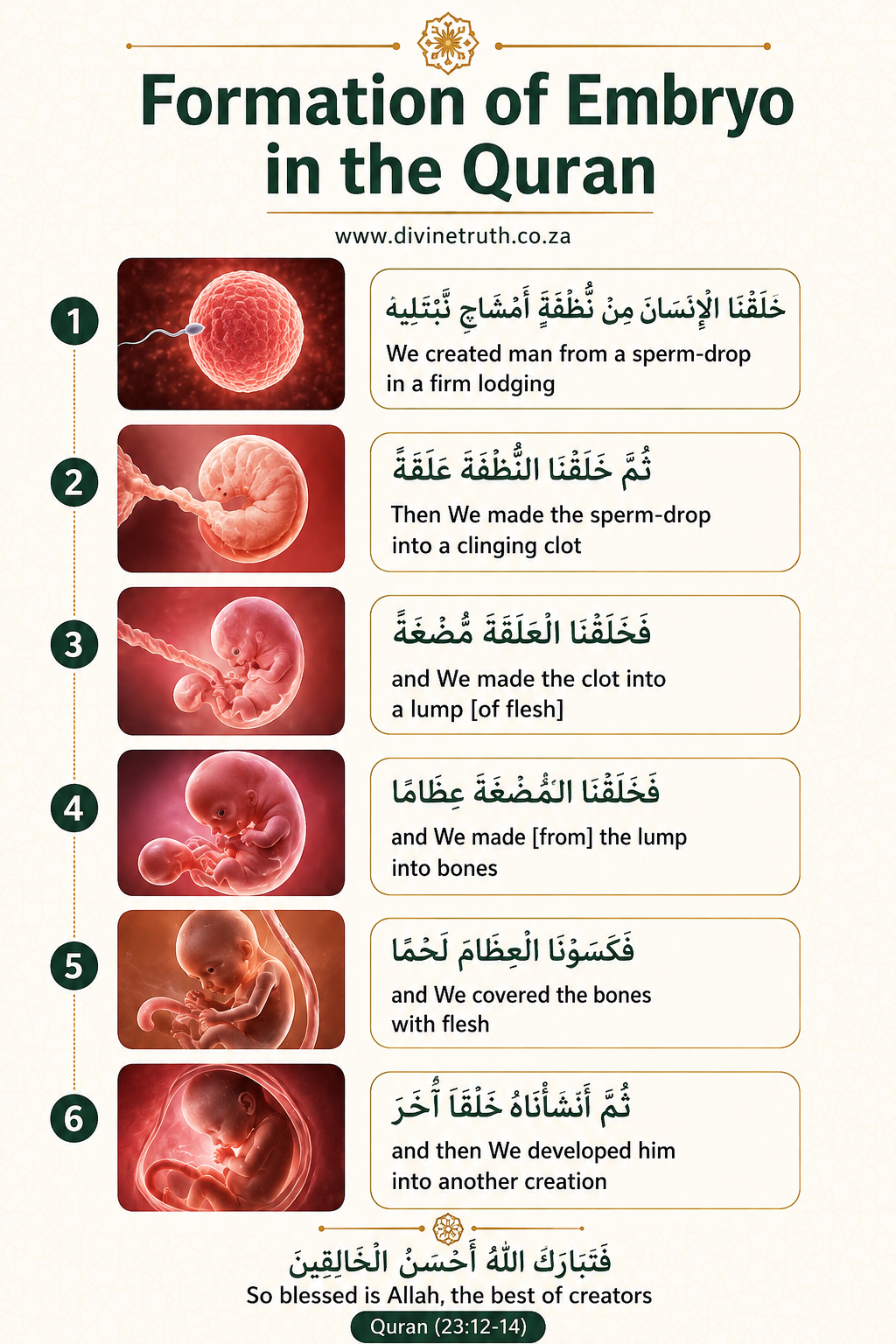
The Qur'an repeatedly draws attention to the hidden nature of this development:
“He creates you in the wombs of your mothers, creation after creation, within three darknesses.”
Qur'an 39:6
The phrase “creation after creation” is consistent with the Qur'an's repeated presentation of human development as a succession of stages rather than as an instantaneous event. Modern embryology likewise understands development as a continuous sequence of transformations in which the embryo changes dramatically in form and organisation.
The Clinging Form
Among the Qur'anic descriptions of embryonic development, the word ʿalaqah is particularly significant. The term has a range of meanings in classical Arabic, including something that clings, a clinging substance and a blood-related description. Classical exegetes interpreted the expression within the context of embryonic development and the appearance of the developing embryo.[33]
The word's basic meaning of something that clings is especially relevant to implantation. Following fertilisation, the developing embryo travels toward the uterus and becomes implanted in the uterine lining. The embryo subsequently develops within the uterine environment while remaining attached to maternal tissue through increasingly complex biological structures.
The Qur'an's description is brief, but the imagery is striking. The developing human being is not initially described as a miniature formed human. Instead, the text moves through successive descriptions of transformation.
Another passage states:
“O mankind, if you are in doubt about the resurrection, then indeed We created you from dust, then from a sperm-drop, then from a clinging clot, then from a lump, formed and unformed—that We may show you.”
Qur'an 22:5
The phrase “formed and unformed” is particularly interesting because embryonic development involves stages in which some structures become recognisable while others have not yet acquired their final form. Classical tafsir records explanations of the expression in relation to the developing embryo, while modern embryology provides detailed observations of the changing morphology of the embryo during these stages.[34]
The Embryo as a “Lump”
The Qur'an subsequently describes the embryo as muḍghah:
“Then We created the clinging clot into a lump, then We created the lump into bones, then We clothed the bones with flesh...”
Qur'an 23:14
The Arabic muḍghah literally evokes something that has been chewed or bears the appearance of something chewed. The description has attracted attention because certain stages of early embryonic development display a segmented appearance associated with the formation of somites along the developing body axis.
Modern embryology recognises the importance of somites in the organisation of the developing embryo. These segmented structures contribute to the formation of the vertebral column, skeletal muscles and other tissues. Their external arrangement can give the embryo an appearance that has been compared to a small chewed substance.
The Qur'an does not employ modern embryological terminology, nor does it describe somites or their developmental biology. Yet the brief visual description of a muḍghah provides an intriguing correspondence with the appearance of the embryo during an early stage of development.
Bones and Flesh
The sequence continues with the statement that the muḍghah becomes bones and that the bones are then clothed with flesh:
“Then We created the lump into bones, then We clothed the bones with flesh; then We brought him into being as another creation.”
Qur'an 23:14
This passage has generated substantial discussion because modern embryological development does not consist of a simple process in which a complete skeleton forms first and only afterward receives muscle tissue. Bone, cartilage, muscle and connective tissues develop through overlapping and interacting processes.
Classical Muslim interpretation of the verse should therefore be distinguished from a modern reconstruction of embryological chronology. Classical exegetes described the verse according to the developmental sequence understood in their time, while modern embryology provides a much more detailed account of tissue differentiation and development.[35]
The significance of the passage lies in the Qur'an's overall sequence rather than in forcing modern terminology into the Arabic. The text presents a succession from reproductive fluid to a clinging stage, then to a developing lump, followed by the emergence of skeletal and muscular structures and finally a further stage of human development.
The Development of the Human Being in the Womb
The Qur'an returns repeatedly to human development as evidence of Allah's creative power. One passage asks:
“What is the matter with you that you do not attribute to Allah due grandeur, while He has created you in stages?”
Qur'an 71:13–14
The Arabic expression ṭawār, translated here as “stages,” conveys the idea of successive states or phases. The Qur'an therefore presents human existence as a process of transformation rather than a single moment of creation.
Another passage states:
“He created you from one soul, then made from it its mate, and He sent down for you of livestock eight mates. He creates you in the wombs of your mothers, creation after creation, within three darknesses.”
Qur'an 39:6
The reference to “three darknesses” has traditionally been interpreted in various ways, including references to successive coverings or layers surrounding the developing fetus.[36] Modern anatomy demonstrates that the fetus develops within a complex environment consisting of the uterine wall, surrounding membranes and the abdominal and pelvic structures of the mother. The Qur'anic description is concise, while the precise identification of the “three darknesses” remains a subject of interpretation.
From Water to Living Beings
The Qur'an connects human development with a broader statement concerning the origin of living things:
“And We made from water every living thing.”
Qur'an 21:30
Water is indispensable to all known terrestrial life. It forms the principal component of the human body, is essential to cellular metabolism and provides the medium in which countless biochemical reactions occur. Modern biology consequently regards water as fundamental to the functioning and survival of living organisms.
The Qur'an repeatedly returns to this connection:
“And Allah has created every living creature from water.”
Qur'an 24:45
The statement is remarkably broad. It does not restrict the importance of water to human beings or to one particular organism. It places living creatures generally within a relationship to water.
The scientific understanding of life remains a developing field, particularly concerning the ultimate origin of life. Yet the dependence of known terrestrial life upon water is not disputed. Every known biological system requires water for its fundamental processes.
The Creation of Humanity and the Question of Origin
The Qur'an also connects human development with the larger question of human origin. It describes humanity as created from earthly material while simultaneously describing individual human beings as developing from reproductive fluid within the womb.
“And of His signs is that He created you from dust; then suddenly you are human beings dispersing throughout the earth.”
Qur'an 30:20
The Qur'anic account therefore operates at several levels. Adam's creation is presented in terms of earthly origin, while subsequent human reproduction occurs through biological processes. The Qur'an moves between the origin of humanity as a species, the creation of the individual and the stages through which each human being develops before birth.
This layered presentation is characteristic of the Qur'an's treatment of creation. A single subject can be viewed from the perspective of its ultimate origin, its immediate biological process and its significance as a sign of Allah.
The Preservation of Pharaoh
The Qur'an contains another remarkable statement concerning Pharaoh. During the account of Musa عليه السلام and the Exodus, Pharaoh pursues the Israelites and is ultimately overwhelmed by the sea. As he faces death, he declares belief, but the Qur'an records Allah's response:
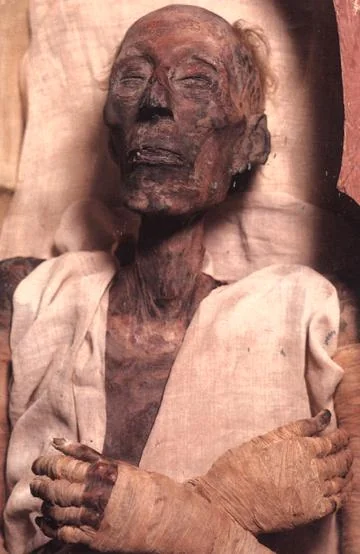
“So today We will preserve your body so that you may be a sign for those after you. And surely many people are heedless of Our signs.”
Qur'an 10:92
The statement is distinctive because it does not merely describe Pharaoh's destruction. It says that his body would be preserved as a āyah, a sign for people who came afterward.
The identity of the historical Pharaoh associated with the Exodus remains debated among historians and Egyptologists. The Qur'an itself does not provide a personal name. Consequently, the scientific and historical significance of the verse does not depend upon assigning the Qur'anic Pharaoh to one particular Egyptian ruler with absolute certainty.
What is remarkable is the Qur'an's explicit statement that Pharaoh's body would be preserved as a sign for later generations. Ancient Egypt practised elaborate embalming and mummification, and numerous royal Egyptian bodies have survived into the modern era. Egyptian mummification developed over many centuries and was specifically intended to preserve the body for the afterlife.[37]
The existence of preserved royal mummies therefore provides a striking historical context for the Qur'anic statement. A body that would otherwise have been expected to disappear with the passing of centuries could remain physically present and become an object of examination by later generations.
The Qur'an's language is particularly significant because it identifies the preserved body itself as a sign. The purpose of the preservation is not merely historical curiosity. It is presented as something through which later people may reflect upon the fate of a ruler who claimed power against Allah.
A Sign Preserved for Later Generations
The passage concerning Pharaoh differs from the cosmological and biological examples because it concerns a historical individual rather than a natural process. Yet it belongs naturally within the Qur'an's broader presentation of signs.
The Qur'an repeatedly tells its readers that the remains of earlier peoples can serve as warnings and evidence. Ruined settlements, abandoned cities and the fate of earlier rulers are presented as visible reminders of the consequences of rejecting divine guidance.
Pharaoh's body is therefore presented within a distinctive theological framework. The ruler who once possessed political power and commanded an empire ultimately became powerless before death. His body, which the Qur'an says would be preserved, became a sign for generations who would come long after him.
The combination is striking: the Qur'an speaks of the body being preserved before modern archaeology and Egyptology made the surviving royal mummies of ancient Egypt objects of scientific and historical investigation. The preserved remains of ancient Egyptian rulers now allow modern people to look directly upon physical evidence from a civilisation that disappeared thousands of years ago.
The Signs Within Humanity and History
The examples examined in this section extend from the beginning of the universe to the formation of the human being and the remains of ancient rulers. They encompass cosmology, oceanography, atmospheric science, geology, astrophysics, embryology and ancient history.
The Qur'an itself brings these dimensions together. It directs the reader toward the heavens, the earth, the human being and the remains of earlier peoples. The signs are therefore not confined to one branch of knowledge. They appear throughout the world that human beings inhabit and within the history through which humanity has passed.
This is consistent with the Qur'an's broader declaration:
“We will show them Our signs in the horizons and within themselves until it becomes clear to them that it is the truth.”
Qur'an 41:53
The scientific discoveries of the modern age have opened many of the horizons to which this verse directs attention. Telescopes reveal the vastness and history of the cosmos. Oceanographic instruments reveal structures within the seas. Microscopes and medical imaging reveal the hidden stages of human development. Geology reveals the structures beneath mountains. Astrophysics traces the origin of elements. Archaeology and Egyptology uncover the remains of ancient civilisations.
What was invisible to the first generations of Muslims can now, in many cases, be observed directly.
The Qur'an's signs therefore continue to unfold before successive generations. Its verses remain the same, while humanity's ability to investigate the creation described by those verses continues to expand.
The Fingerprints
The Qur'an brings the signs of creation even closer to the individual human being. In a passage concerning resurrection, Allah states:
“Does man think We cannot reassemble his bones? Yes indeed! We are able to restore even his fingertips.”
Qur'an 75:3–4
The reference to the fingertips is striking because the Qur'an could simply have stated that Allah is able to reconstruct the human bones. Instead, it draws attention specifically to the fingertips.
The Arabic expression banānah refers to the fingers or fingertips. Classical exegetes understood the verse primarily as an expression of Allah's complete power to reconstruct the human being down to the smallest details of the body.[38]

The verse is therefore fundamentally concerned with resurrection, not with presenting a scientific theory of fingerprint identification. Modern forensic science has nevertheless demonstrated the extraordinary individuality and persistence of friction-ridge patterns on the fingertips. Fingerprints develop before birth and generally remain stable throughout an individual's life, making them one of the most widely used biological characteristics for personal identification.[39]
The scientific significance of the Qur'anic wording lies in the fact that the fingertips are among the most individually distinctive parts of the human body. Modern forensic identification makes use of precisely this individuality. A person's fingerprints can distinguish that individual from another even when other physical characteristics are extremely similar.
The Qur'an's argument, however, reaches beyond identification. The fingertip is presented as an example of the precision with which Allah can reconstruct the human being after death. The very feature that modern science has discovered to possess extraordinary individual characteristics becomes, within the Qur'anic argument, a sign of the precision of divine creation and the possibility of resurrection.
The Signs Within Humanity
The examples examined in this section have moved from the largest scales imaginable to the smallest details of human existence. The Qur'an directs attention to the origin and development of the universe, the expansion of the heavens, the early state of creation, the depths of the oceans, the atmosphere surrounding the earth, mountains, iron, embryological development, water, wind and even the individual fingertips.
The subjects belong to different branches of knowledge, yet the Qur'an presents them within a single vision of creation. The universe is ordered. The earth sustains life. Winds participate in processes of fertilisation. Living beings develop through stages. Elements have cosmic histories. Even the smallest details of the human body bear the marks of individuality.
The Qur'an repeatedly returns the reader to the same conclusion:
“We will show them Our signs in the horizons and within themselves until it becomes clear to them that it is the truth.”
Qur'an 41:53
The scientific age has given humanity unprecedented means of observing these signs. Telescopes reveal the distant universe; satellites observe the earth and its atmosphere; oceanographic instruments penetrate the depths of the seas; geological science examines the structure of mountains; astrophysics traces the origin of elements; medical imaging reveals development within the womb; and forensic science can distinguish individuals through the patterns on their fingertips.
The Qur'an, however, remains the same revelation that was recited by Muhammad ﷺ more than fourteen centuries ago.
Its verses did not change when the telescope was invented, when the microscope revealed the hidden world of biology, when modern hydrology mapped the circulation of water, or when astrophysics uncovered the stellar origin of elements. The knowledge of humanity expanded, while the Qur'anic text remained unchanged.
This is the distinctive character of the Qur'an as a continuing miracle. Earlier prophets were given signs witnessed by their contemporaries. Muhammad ﷺ was given many signs, but the Qur'an itself remained as a sign that later generations could read, hear, examine and contemplate. Its challenge, its language, its message and the signs contained within its descriptions continue to confront each generation with the same fundamental question: what is the source of this Book?
For Muslims, the answer is the foundation upon which the entire Qur'anic message rests. The Book that repeatedly directs humanity to signs in the heavens, the earth and within themselves presents those signs as coming from the One who created them.
The Signs Continue to Unfold
The examples examined in this section have moved from the largest scales imaginable to the smallest details of human existence. The Qur'an directs attention to the origin and development of the universe, the expansion of the heavens, the early state of creation, the depths of the oceans, the atmosphere surrounding the earth, mountains, iron, water, embryonic development and even the individual fingertips.
The subjects belong to different branches of knowledge, yet the Qur'an presents them within a single vision of creation. The universe is ordered. The earth sustains life. Water moves through a vast natural cycle. Winds participate in processes of fertilisation. Living beings develop through stages. Elements have cosmic histories. Even the smallest details of the human body bear the marks of individuality.
The Qur'an repeatedly returns the reader to the same conclusion:
“We will show them Our signs in the horizons and within themselves until it becomes clear to them that it is the truth.”
Qur'an 41:53
The scientific age has given humanity unprecedented means of observing these signs. Telescopes reveal the distant universe; satellites observe the earth and its atmosphere; oceanographic instruments penetrate the depths of the seas; geological science examines the structure of mountains; astrophysics traces the origin of elements; medical imaging reveals development within the womb; and forensic science can distinguish individuals through the patterns on their fingertips.
The Qur'an, however, remains the same revelation that was recited by Muhammad ﷺ more than fourteen centuries ago.
Its verses did not change when the telescope was invented, when the microscope revealed the hidden world of biology, when modern hydrology mapped the circulation of water, or when astrophysics uncovered the stellar origin of elements. The knowledge of humanity expanded, while the Qur'anic text remained unchanged.
This is the distinctive character of the Qur'an as a continuing miracle. Earlier prophets were given signs witnessed by their contemporaries. Muhammad ﷺ was given many signs, but the Qur'an itself remained as a sign that later generations could read, hear, examine and contemplate. Its challenge, its language, its message and the signs contained within its descriptions continue to confront each generation with the same fundamental question: what is the source of this Book?
Quran Proprophecies
Prophecy as a Sign of Revelation
The Qur'an does not limit its signs to the natural world. Among its most remarkable claims are statements concerning events that had not yet occurred when the verses were revealed. Some concern events within the lifetime of Muhammad ﷺ, while others extend into the future and remain connected with the Qur'an's broader descriptions of human history, political events and the final destiny of humanity.
The significance of prophecy within the Qur'an's claim to divine revelation is clear. A human being can describe the past from knowledge, observation or transmitted reports, and can speculate about the future, but knowledge of an event before it occurs belongs to a different category. The Qur'an repeatedly presents knowledge of the unseen future as belonging ultimately to Allah and identifies the disclosure of such knowledge through revelation as a sign of prophethood.
“He is the Knower of the unseen, and He does not disclose His unseen to anyone, except to a messenger He has chosen.”
Qur'an 72:26–27
The Qur'an therefore presents prophecy not simply as prediction but as revealed knowledge. When a future event is announced with sufficient specificity and subsequently occurs, the event becomes part of the evidence surrounding the revelation.
The Qur'an also reminds Muhammad ﷺ that knowledge of the unseen was not something he possessed independently:
“Say, ‘I do not tell you that I possess the treasures of Allah, nor that I know the unseen, nor do I tell you that I am an angel. I only follow what is revealed to me.’”
Qur'an 6:50
The distinction is important. Muhammad ﷺ is presented as the recipient of revelation rather than the independent source of supernatural knowledge. When the Qur'an announces something beyond the knowledge of its immediate audience, the knowledge is attributed to Allah.
This feature of the Qur'an becomes particularly significant when a prophecy concerns an event whose outcome could not reasonably have been known when the prediction was revealed. The Qur'an contains several such passages, but one of the clearest examples concerns a major war between the Byzantine Roman Empire and the Persian Empire.
The Defeat and Restoration of the Romans
During the early seventh century, the Byzantine Roman Empire suffered devastating defeats at the hands of the Sasanian Persian Empire. Persian forces captured major Byzantine territories, including Syria and Palestine, and in 614 CE captured Jerusalem. Egypt was subsequently lost to the Persians, placing the Byzantine Empire under extraordinary military and political pressure.[40]
It was against this historical background that the Qur'an announced:
“The Romans have been defeated in the nearest land. Yet after their defeat, they will triumph within a few years. To Allah belongs the command before and after. And on that day the believers will rejoice.”
Qur'an 30:2–4
The Arabic expression biḍʿ sinīn indicates a small number of years, traditionally understood as a period between three and nine years. The prophecy therefore did not merely state that the Romans would eventually recover at some unspecified point in the distant future. It placed their recovery within a defined period.[41]
The historical circumstances made the prediction particularly striking. The Byzantine Empire had suffered a series of catastrophic defeats and appeared to be approaching collapse. Jerusalem had fallen in 614 CE, and the Persians had advanced deeply into Byzantine territory. The empire's survival itself appeared uncertain.[42]
Yet the political and military situation subsequently changed. Emperor Heraclius reorganised Byzantine forces and launched a counteroffensive against the Persians. From 622 CE onward, Byzantine military successes transformed the course of the war, and the Persians were eventually compelled to negotiate. The conflict ended with the restoration of territories captured by Persia, including the return of the True Cross to Jerusalem in 630 CE.[43]
The prophecy is remarkable because the Qur'an was revealed while the Byzantine position appeared extremely weak, yet it announced that the Romans would recover within a limited number of years.
The passage contains another significant detail. It links the Roman victory with the believers' joy:
“And on that day the believers will rejoice.”
Qur'an 30:4
The Qur'an's prediction therefore concerns not merely the eventual outcome of a war but places that outcome within the historical circumstances of the early Muslim community.
The event became one of the earliest examples cited by Muslim scholars in discussions of Qur'anic prophecy. The Qur'an had spoken while the outcome remained uncertain, and the subsequent reversal of the war provided a historical event through which the prophecy could be examined.
The Significance of the Roman Prophecy
The importance of the passage lies in the combination of its historical setting, its prediction of reversal and its stated time frame. The Romans had suffered a severe defeat, yet the Qur'an announced that they would recover within a relatively short period.
The Byzantine victory did not occur because the Roman Empire suddenly became militarily invulnerable. The subsequent war remained extraordinarily destructive for both sides. What changed was the direction of the conflict. Heraclius' campaigns from 622 CE onward reversed the strategic situation and eventually forced Persia to surrender its conquests.[44]
The Qur'anic passage consequently provides one of the clearest examples in which a statement about the future can be placed alongside independently documented historical events. The prediction was made before the outcome became apparent, and the subsequent Roman recovery occurred within the period specified by the Qur'an.
For the Qur'an, however, the event was never merely a political prediction. The passage concludes by directing attention back to Allah:
“To Allah belongs the command before and after.”
Qur'an 30:4
The rise and fall of empires, the reversal of military fortunes and the movement of history are presented as events occurring within Allah's knowledge and decree.
The Roman prophecy therefore introduces another dimension of the Qur'an's claim to revelation. The Qur'an speaks not only about the creation that surrounds humanity but also about history that lies ahead of it. In this case, a future political reversal was announced at a moment when the historical circumstances appeared to point in the opposite direction.
The Victory at Badr
The Qur'an contains another prophecy whose fulfilment occurred within the lifetime of Muhammad ﷺ and the first Muslim community. Before the Battle of Badr, the Muslims were a small and comparatively poorly equipped force, while the opposing Quraysh represented the dominant military and economic power of Makkah.
The Qur'an records that Allah had already promised the believers that one of the two opposing groups would fall into their hands:
“And when Allah promised you that one of the two groups would be yours, and you wished that the unarmed group would be yours, but Allah intended to establish the truth by His words and to eliminate the disbelievers.”
Qur'an 8:7
The two groups were the approaching Quraysh force and the commercial caravan returning from Syria. The Muslims had originally set out in connection with the caravan, while the Quraysh mobilised a much larger armed force after learning of the Muslim movement. The Qur'anic passage records that the believers preferred the less heavily defended objective, while Allah's decree brought them into confrontation with the armed Quraysh force.[45]
The Qur'an then describes the coming encounter in terms that were extraordinary given the circumstances:
“Remember when Allah showed them to you in your dream as few. Had He shown them to you as many, you would certainly have lost courage and disputed about the matter. But Allah saved you from this. Surely He knows best what is in the hearts.”
Qur'an 8:43
The Muslim force consisted of approximately 300 men, while the Quraysh army numbered roughly 1,000. The difference in numbers and equipment was substantial. The Battle of Badr nevertheless ended in a decisive Muslim victory, with a significant number of Quraysh leaders killed and others taken prisoner.[46]
The Qur'an had also indicated that the believers would encounter the opposing army and that the encounter would result in a decisive outcome:
“And when you met, He showed them to you as few in your eyes and made you few in their eyes, so that Allah might accomplish a matter already destined to occur. And to Allah all matters return.”
Qur'an 8:44
The historical importance of Badr extends beyond its military outcome. It became the defining early victory of the Muslim community and profoundly altered the political situation in Arabia. A community that had recently been persecuted and driven from Makkah had defeated the leading military force of the city from which it had been expelled.
The Qur'an subsequently refers to Badr as the “Day of Criterion”:
“If you believe in Allah and in what We sent down to Our servant on the Day of Criterion—the day the two armies met. And Allah is over all things competent.”
Qur'an 8:41
The expression “Day of Criterion” reflects the Qur'anic understanding of the battle as a decisive moment separating two opposing orders: the emerging Muslim community and the established power of Quraysh.
The Conquest of Makkah
The Qur'an also contains a prophecy concerning the believers' eventual entry into the Sacred Mosque. At the time this was revealed, Makkah remained under Quraysh control and the Muslims had not yet conquered the city.
“Certainly has Allah fulfilled for His Messenger the vision in truth: you will surely enter the Sacred Mosque, if Allah wills, in safety, with your heads shaved and hair shortened, not fearing anyone. He knew what you did not know and granted before that a conquest near at hand.”
Qur'an 48:27
The verse describes a future event with remarkable specificity. The believers would enter the Sacred Mosque in security, performing the rites associated with pilgrimage. The statement was revealed in the context of the events surrounding the Treaty of Hudaybiyyah, when the Muslims had attempted to perform pilgrimage but had been prevented from entering Makkah.
The immediate historical circumstances therefore made the prophecy particularly significant. The Muslims had not entered Makkah as pilgrims, and the city remained under Quraysh authority. Yet the Qur'an assured them that the vision would be fulfilled.[47]
Two years later, following the breakdown of the Hudaybiyyah settlement and the subsequent political developments, Muhammad ﷺ entered Makkah with a large Muslim force. The city surrendered with comparatively little fighting, and the Muslims entered the Sacred Mosque in accordance with the Qur'anic description.[48]
The prophecy was therefore fulfilled within the lifetime of the people who had first heard it. The Qur'an had spoken of an event that had not yet occurred, while the political circumstances at the time did not provide certainty that such an outcome was imminent.
The Spread of Islam
The Qur'an also contains broader statements concerning the establishment and expansion of the religion brought by Muhammad ﷺ:
“He is the One Who sent His Messenger with guidance and the religion of truth, so that He may make it prevail over every religion, even though the polytheists dislike it.”
Qur'an 61:9
A similar statement occurs in Qur'an 48:28 and Qur'an 9:33. The repeated formulation places the future expansion of Islam within the Qur'an's understanding of divine purpose.
At the time of revelation, the Muslim community was a relatively small Arabian movement surrounded by powerful political and religious opponents. Within a comparatively short historical period, however, Muslim rule expanded throughout Arabia and subsequently beyond the Arabian Peninsula into territories governed by the Byzantine and Sasanian empires.[49]
The historical development does not mean that every later political event can simply be identified as a literal fulfilment of the verse. The Qur'anic statement is broader than a prediction of one particular battle or empire. Its significance lies in the remarkable transformation of a persecuted community into a civilisation whose religious tradition spread across vast geographical regions.
The prophecy concerning the Romans and the prophecies concerning Badr and the entry into Makkah are more historically specific. Together, however, they illustrate a recurring feature of the Qur'an: it sometimes speaks about events that were still in the future and presents their eventual occurrence as part of the evidence of revelation.
The Qur'an's Prophetic Pattern
The prophecies examined here differ in scale. The Roman prophecy concerns an international war between two great empires. Badr concerns the survival of the early Muslim community. The prophecy concerning Makkah concerns the future return of the Muslims to the city from which they had been expelled. The broader prophecy concerning the spread of Islam extends beyond the lifetime of Muhammad ﷺ.
Yet each belongs to the same Qur'anic pattern. Events that had not yet occurred were placed before the believers as promises or declarations concerning the future. Some were fulfilled within years, others within the lifetime of the first generation, and the broader historical consequences continued to unfold afterward.
The Qur'an itself draws attention to the distinction between ordinary human knowledge and revealed knowledge of the future. Its prophecies are therefore presented not as guesses but as part of the revelation given to Muhammad ﷺ.
The significance becomes especially clear when the circumstances surrounding the original statements are remembered. The Roman Empire appeared close to collapse before its recovery. The Muslims at Badr were vastly outnumbered. The Muslims at Hudaybiyyah had been prevented from entering Makkah. Yet the Qur'an spoke with confidence about outcomes that had not yet occurred.
The Preservation of the Muslim Community
The Qur'an contains another prophecy concerning the future of the Muslim community itself. At a time when the believers were still a relatively small community facing hostility and military opposition, the Qur'an announced that Allah would establish them securely in the land and transform their condition from fear to security.
“Allah has promised those of you who believe and do righteous deeds that He will surely grant them succession upon the earth, just as He granted it to those before them; and that He will surely establish for them their religion which He has chosen for them; and that He will surely replace their fear with security. They worship Me, associating nothing with Me.”
Qur'an 24:55
The statement contains several distinct promises: succession or authority in the land, establishment of the religion, and the transformation of fear into security. These were not abstract ideas for the first Muslim community. The early Muslims had experienced persecution in Makkah, migration to Abyssinia and Madinah, military conflict and the continuing threat of destruction from surrounding opponents.
The historical development of the Muslim community subsequently followed a dramatic trajectory. From the small community established in Madinah, Muslim political authority expanded across Arabia during the lifetime of Muhammad ﷺ. After his death, the early caliphate extended Muslim rule into territories previously governed by the Byzantine and Sasanian empires.[50]
The prophecy is therefore significant because it was given to a community whose immediate circumstances did not resemble the political dominance described in the verse. The Qur'an presented the transformation from fear to security and from vulnerability to established authority as something Allah had promised.
The verse concludes with a condition concerning the community's relationship with Allah:
“They worship Me, associating nothing with Me.”
Qur'an 24:55
The prophecy therefore combines political transformation with religious establishment. The Qur'an does not present the future success of the community merely as territorial expansion. It connects that success with the establishment of the religion and the worship of Allah alone.
The Promise of Victory
The Qur'an also repeatedly reassures the believers that the opposition confronting them would not ultimately prevail against Allah's Messenger and the believers.
“They wish to extinguish the light of Allah with their mouths, but Allah will perfect His light, even though the disbelievers dislike it.”
Qur'an 61:8
The same statement appears in connection with the Qur'an's description of the mission of Muhammad ﷺ:
“He is the One Who sent His Messenger with guidance and the religion of truth to make it prevail over every other religion, even though the polytheists dislike it.”
Qur'an 61:9
At the beginning of Muhammad's mission, the proposition that the new faith would overcome the established religious order of Arabia was far from obvious. The Prophet ﷺ and his followers faced sustained opposition from Quraysh, and the early Muslims were a minority without the political or military resources of the surrounding powers.
The subsequent history of Arabia was nevertheless transformed within a single generation. Makkah came under Muslim control, the major Arabian tribes entered into alliances with or accepted the authority of the Muslim polity, and Islam became the dominant religious and political force across the peninsula.[51]
The prophecy therefore belongs to the same historical pattern as the prediction concerning the conquest of Makkah. The Qur'an spoke of the future triumph of the message while the Messenger and his followers were still confronting powerful opposition.
The Return of the Prophet to Makkah
Another Qur'anic passage contains a promise concerning Muhammad ﷺ himself:
“Indeed, the One Who ordained the Qur'an for you will surely bring you back to the place of return.”
Qur'an 28:85
The phrase “place of return” (maʿād) has been interpreted by Muslim exegetes in different ways, including a reference to the Prophet's return to Makkah.[52]] This interpretation is particularly significant in light of Muhammad's forced departure from the city.
Muhammad ﷺ had left Makkah as a persecuted messenger and migrated to Madinah. At the time of the Hijrah, there was no guarantee that he would ever return as its victorious leader. Yet within several years he returned to Makkah, and the city came under Muslim authority.
The event provides another example of a Qur'anic statement being understood by early Muslims in connection with an event that subsequently occurred. The man who had been forced to leave Makkah returned to the city, not as a fugitive but at the head of the victorious Muslim community.
The Defeat of Those Who Opposed the Messenger
The Qur'an also makes a broader prediction concerning those who opposed Muhammad ﷺ:
“Indeed, those who oppose Allah and His Messenger will be among the most humbled.”
Qur'an 58:20
This statement was not limited to one individual or one battle. It formed part of the Qur'an's broader declaration that opposition to the Messenger would ultimately fail.
The history of early Islam provides a striking context for this claim. The Quraysh had attempted to suppress Muhammad's message through social pressure, economic sanctions, persecution and military confrontation. Yet the movement survived, established itself in Madinah and eventually entered Makkah itself.[53]
The transformation was dramatic. The same city that had expelled Muhammad ﷺ became the centre of the pilgrimage associated with his message. The sanctuary that had been controlled by the Quraysh became the central sanctuary of Islam, and the idols that had surrounded the Kaʿbah were removed during the conquest of Makkah.
The Qur'an's prophecies concerning the future of the Muslim community therefore unfolded against circumstances in which their fulfilment could not simply be assumed from the political situation at the time.
Prophecy Beyond the First Generation
The Qur'an's prophetic statements are not confined to the immediate political history of Muhammad ﷺ. It also contains predictions concerning developments that extend beyond his lifetime.
One example is the Qur'an's repeated assertion that the religion would spread beyond the circumstances of its original Arabian setting. Another concerns the continued preservation of the Qur'an itself:
“Indeed, it is We who sent down the Reminder, and surely We will guard it.”
Qur'an 15:9
The verse is primarily a divine declaration concerning the preservation of the revelation. Its historical significance became increasingly visible as the Qur'an was transmitted through memorisation, written copies and a standardised written tradition that spread throughout the Muslim world.
The Qur'an has consequently remained the central scripture of Islam across more than fourteen centuries, recited in its original Arabic in communities extending from Arabia across Africa, Asia and later Europe and the Americas.
The Qur'anic claim of preservation is therefore itself connected with a historical phenomenon extending across generations. The text that Muhammad ﷺ recited remains the text recited by Muslims today.
The Pattern of Qur'anic Prophecy
The prophecies examined so far operate on different historical scales. The Roman prophecy concerned a major international conflict. The prophecy concerning Badr concerned a battle that had not yet occurred. The promise concerning the Sacred Mosque anticipated the Muslims' return to Makkah. The prophecy concerning the Muslim community anticipated a transformation from vulnerability to established authority. Other statements concern the continued establishment and preservation of the Qur'anic message.
The common feature is that the Qur'an repeatedly speaks about what lies beyond the immediate circumstances of its first audience.
Some prophecies were fulfilled within a few years. Others unfolded across the lifetime of the first Muslim generation. Still others concern the continuing history of the Qur'an and its religious community.
This prophetic dimension forms another part of the Qur'an's claim to be revelation. It presents knowledge of events beyond the immediate horizon of its first audience and attributes that knowledge to Allah.
The historical record then provides the opportunity to compare the Qur'anic statements with the events that followed.
The Future Preservation of the Qur'an
The Qur'an contains a remarkable claim concerning its own preservation. Rather than presenting the continued survival of the revelation as something dependent solely upon human effort, it attributes the preservation of the revealed message directly to Allah:
“Indeed, it is We who sent down the Reminder, and surely We will guard it.”
Qur'an 15:9
The statement was made at a time when the Qur'an was still being revealed and the Muslim community was still in its formative period. The complete written Qur'an as a single codex did not yet exist, and its preservation depended upon a combination of memorisation, recitation and written recording. Yet the Qur'an declared that the revelation would be guarded.
The historical transmission of the Qur'an subsequently developed through several complementary forms. Muhammad ﷺ taught the revealed passages to his companions, who memorised them and recited them publicly and privately. Qur'anic material was also written during his lifetime on materials available in seventh-century Arabia. After his death, the revelations were collected into a codex, and during the caliphate of ʿUthmān ibn ʿAffān, standard written copies were produced and distributed to major centres of the expanding Muslim community.[54]
The preservation of the Qur'an therefore did not depend upon a single manuscript or a single generation. It developed through a transmission system in which oral memorisation and written copies reinforced one another.
The Qur'an itself repeatedly emphasises its status as a revelation that was recited and preserved among the believers:
“Rather, these are clear verses preserved in the hearts of those who have been given knowledge.”
Qur'an 29:49
The continuing existence of large communities of Qur'an memorizers represents a distinctive feature of the scripture's transmission. Complete memorisation of the Qur'an became an established religious practice, and the text continues to be recited from memory throughout the Muslim world.
The Qur'an's Promise of Protection
The wording of Qur'an 15:9 is particularly significant because the Qur'an does not merely say that Allah sent down the revelation. It adds an explicit promise concerning its protection.
This claim can be examined historically because the Qur'an's transmission leaves an extensive manuscript and oral record. Early Qur'anic manuscripts survive from the first centuries of Islam, while fragments and codices provide physical evidence concerning the transmission of the text. Among the earliest surviving witnesses are manuscripts associated with the first Islamic centuries, including the Birmingham Qur'an manuscript, the Ṣanʿāʾ manuscripts and other early Qur'anic codices.[55]
The manuscript evidence does not mean that every surviving early manuscript is identical in every orthographic detail. Early Arabic manuscripts were written before the fully developed system of vowel marks and consonantal pointing used in later manuscripts, and differences in spelling and orthography occur. The broader manuscript evidence nevertheless demonstrates the remarkable antiquity and stability of the Qur'anic textual tradition.[56]
This historical evidence becomes especially significant when considered alongside the continuing oral transmission of the Qur'an. A manuscript can be examined as a physical artefact, while oral transmission preserves the text through recitation and memorisation. The two forms of transmission existed together from the earliest period.
The Qur'an and Its Continued Recitation
The Qur'an also describes itself as a revelation intended to be recited:
“Indeed, upon Us is its collection and its recitation. So when We have recited it, then follow its recitation.”
Qur'an 75:17–18
The passage is addressed to Muhammad ﷺ during the process of revelation. It describes Allah's role in ensuring that the revelation is gathered and recited correctly. The historical Islamic tradition subsequently developed an elaborate system of Qur'anic recitation in which teachers transmitted the text orally through chains of instruction.
This produced a form of preservation that was not dependent upon literacy alone. A person could learn the complete Qur'an through hearing and memorisation, while the written text provided an additional means of verification.
The result was an unusual combination: a scripture preserved simultaneously as a written text and as a memorised oral text.
The Qur'an itself highlights this accessibility:
“And We have certainly made the Qur'an easy for remembrance, so is there anyone who will remember?”
Qur'an 54:17
The repeated appearance of this statement throughout Surah al-Qamar emphasises memorisation and remembrance as features of the Qur'anic revelation.
The Qur'an's Survival Across Civilisations
The historical significance of this preservation becomes clearer when the geographical expansion of Islam is considered. The Qur'an travelled beyond the Arabian Peninsula into communities speaking Persian, Greek, Coptic, Berber, Latin-derived languages, Turkic languages, African languages and eventually the languages of almost every major region of the world.
Yet the Arabic Qur'an remained the central liturgical text. Muslims in distant regions continued to learn and recite the same Arabic revelation, even when they did not speak Arabic as their everyday language.
This produced an unusual historical phenomenon. Translation allowed the Qur'an's meaning to reach new linguistic communities, but the Arabic text itself remained the text used for ritual recitation. Consequently, the spread of Islam did not require replacing the Arabic scripture with local-language versions.
The Qur'an therefore became a text that crossed political boundaries without becoming dependent upon any single empire or state for its survival.
Empires rose and disappeared. Dynasties changed. Languages developed. Political borders shifted. Yet the Arabic Qur'an continued to be memorised and recited.
A Prophecy Examined Through History
The promise of preservation is different from the earlier prophecies concerning the Romans, Badr or the conquest of Makkah. Those predictions concerned identifiable historical events that occurred after the relevant Qur'anic statements. The preservation statement concerns a continuing process extending across more than fourteen centuries.
Its significance can therefore be considered on two levels.
At the theological level, the Qur'an declares that Allah Himself will guard the revelation.
At the historical level, the Qur'an's transmission can be examined through manuscripts, inscriptions, written copies, memorisation traditions and the continuing practice of recitation.
The resulting historical picture is significant. The Qur'an has remained in continuous use from the earliest Muslim community to the present, while early manuscript evidence demonstrates the antiquity of the textual tradition and the oral tradition provides an additional mechanism of transmission.[57]
The Qur'an's claim therefore invites comparison between its declaration and the historical record. A revelation that announced its own preservation has survived across centuries, languages, political transformations and geographical expansion while retaining its central Arabic textual form.
This places the Qur'an's preservation among its most enduring claims concerning the future.
The Qur'an's Prophecy Concerning the Future of Humanity
The Qur'an's prophecies are not limited to the political events surrounding the first Muslim community. It also speaks about events that extend beyond the lifetime of Muhammad ﷺ and describes developments that would unfold as human history approached its final stages. Some concern the condition of societies, while others concern events associated with the Last Day.
The Qur'an repeatedly presents these future events as matters known ultimately to Allah:
“And with Him are the keys of the unseen; no one knows them except Him. And He knows what is on land and in the sea. Not a leaf falls but He knows it. Nor is there a grain in the darknesses of the earth, nor anything wet or dry, but is recorded in a clear Record.”
Qur'an 6:59
The distinction between ordinary prediction and revelation is therefore maintained throughout the Qur'an. Human beings may make predictions from observation and probability, but the Qur'an presents its statements concerning the unseen and the future as knowledge disclosed by Allah.
Among the most significant examples are the Qur'an's descriptions of the changing condition of human societies and the approach of the final events.
The Signs of the Last Hour
The Qur'an announces that humanity will eventually reach a final period in which the established order of the world will be overturned. The heavens, earth, mountains and seas are repeatedly described as undergoing extraordinary changes.
“When the sun is wrapped up, and when the stars fall, and when the mountains are set in motion, and when the pregnant she-camels are neglected, and when the wild beasts are gathered, and when the seas are set aflame, and when the souls are paired...”
Qur'an 81:1–7
Another passage states:
“When the sky is split apart, and when the stars are scattered, and when the seas burst forth, and when the graves are overturned, each soul will know what it has sent ahead and what it left behind.”
Qur'an 82:1–5
These passages describe a future transformation of the natural order rather than an ordinary historical event. Their significance lies in the Qur'an's claim that the universe itself has a predetermined end and that the visible order of creation is not eternal.
The Qur'an's descriptions of the Last Day are accompanied by repeated assertions that the event will come unexpectedly:
“They ask you about the Hour: when will it arrive? Say, ‘Its knowledge is only with my Lord. None can reveal its time except Him. It is burdensome for the heavens and the earth. It will not come upon you except suddenly.’”
Qur'an 7:187
The Qur'an therefore distinguishes between knowledge that can be revealed and knowledge of the exact moment of the Hour, which remains with Allah alone.
The Emergence of Gog and Magog
One of the Qur'an's most distinctive future events concerns Ya'juj and Ma'juj, commonly identified in English as Gog and Magog.
The Qur'an first introduces them within the account of Dhul-Qarnayn, who encounters a people troubled by their destructive activity:
“They said, ‘O Dhul-Qarnayn! Indeed Gog and Magog are spreading corruption throughout the land. Will you let us pay you a tribute in return for building a barrier between us and them?’”
Qur'an 18:94
Dhul-Qarnayn constructs a barrier between the people and Gog and Magog. The Qur'an then states:
“So they could neither scale it nor tunnel through it. He said, ‘This is a mercy from my Lord. But when the promise of my Lord comes to pass, He will level it to the ground. And the promise of my Lord is always true.’”
Qur'an 18:97–98
The account returns to Gog and Magog near the end of the Qur'an:
“Until when Gog and Magog are let loose and they rush down from every elevation.”
Qur'an 21:96
The Qur'anic presentation therefore establishes a future event in which the barrier associated with Dhul-Qarnayn will cease to restrain them and Gog and Magog will emerge.
The Qur'an does not provide enough information to identify the barrier with certainty as a particular surviving archaeological structure. Nor does it provide a detailed chronology of the events. The significance of the passage lies instead in its clear placement of Gog and Magog within the future events preceding the final judgement.
The Smoke
The Qur'an also contains a prophecy concerning a great smoke:
“So watch for the Day when the sky will bring a visible smoke, enveloping the people. This will be a painful torment.”
Qur'an 44:10–11
The passage continues by describing the people's response and their plea for the punishment to be removed. The Qur'an then refers to the event as a major sign.
The interpretation of this passage has been discussed extensively in Islamic scholarship. Some early exegetes understood the smoke as a historical event experienced by the people of Makkah, while others connected it with a future event preceding the Last Day.[58] The passage should therefore not be presented as though its eschatological interpretation were uncontested across all classical scholarship.
What is clear is that the Qur'an associates the smoke with divine judgement and presents it as an event that will become unmistakable to those who witness it.
The Beast of the Earth
Another future sign is the emergence of a creature from the earth:
“And when the word comes to pass against them, We will bring forth for them a creature from the earth who will speak to them, because the people had no sure faith in Our signs.”
Qur'an 27:82
The Qur'an does not provide a physical description of this creature. Its importance lies in the role assigned to it: its emergence will occur as part of the events leading toward the final reckoning, and it will address humanity concerning their response to Allah's signs.
Classical Islamic tradition subsequently identified this creature as one of the major signs of the Hour, based particularly on authentic Hadith that place the emergence of the Beast among the great signs preceding the Last Day.[59]
The passage therefore provides another example of the Qur'an speaking about an event beyond the immediate historical experience of its first audience.
The Smoke, the Beast and the Final Signs
The Qur'anic descriptions of future events differ from the earlier prophecies concerning the Romans, Badr and the conquest of Makkah. Those historical prophecies concerned events that could subsequently be verified within ordinary human history. The eschatological prophecies concern events that belong to the future and whose complete fulfilment has not yet occurred.
This distinction is important because the evidence available to the present generation is different in each case. Historical prophecies can be compared with records of events that have already taken place. Eschatological prophecies remain claims about the future and therefore cannot be treated as though their fulfilment had already been historically demonstrated.
The Qur'an nevertheless presents these future events with remarkable specificity. Gog and Magog, the Beast, the smoke, the upheaval of the natural order and the final Hour form part of a coherent Qur'anic vision of the conclusion of human history.
The Qur'an's prophetic dimension therefore extends across time. Some predictions have already entered history; others remain awaiting their fulfilment.
The Prophecy Concerning Abu Lahab
Among the Qur'an's most striking prophecies is the declaration concerning Abū Lahab, one of Muhammad's ﷺ most prominent opponents. Unlike prophecies concerning distant political events, this prediction concerned a living individual who could, at least theoretically, have acted in a way that would have challenged the apparent prediction.
The Qur'an states:
“May the hands of Abū Lahab be ruined, and ruined is he. His wealth will not avail him, nor what he has earned. He will burn in a flaming Fire, and so will his wife, the carrier of firewood, around her neck a rope of palm fibre.”
Qur'an 111:1–5
The passage was revealed while Abū Lahab was alive and openly hostile toward Muhammad ﷺ. He was a member of the Prophet's own clan and was among the most persistent opponents of his message. The Qur'anic declaration therefore did not concern a person whose fate was already historically settled. It announced his destruction and continued rejection while he remained an active participant in the events surrounding the Prophet's mission.[60]
The historical significance lies in the nature of the prediction. Abū Lahab lived for years after the revelation of the chapter. During that period, he could have publicly declared belief in Muhammad ﷺ and attempted to use such a declaration to undermine the Qur'anic claim. Instead, he remained an opponent of the Prophet until his death.[61]
The Qur'an's prediction therefore involved more than a statement that Abū Lahab would eventually die. Death was inevitable for every human being. The remarkable element was the Qur'an's declaration that his wealth would not save him and that he would die under the judgement described in the chapter, while his continued rejection of Muhammad's message remained publicly observable.
His wife is also explicitly included in the passage. Umm Jamīl, the wife of Abū Lahab, was likewise known for her hostility toward Muhammad ﷺ and is described in the Qur'an as “the carrier of firewood.” Early Islamic historical and exegetical sources identify her as a member of the opposition surrounding the Prophet.[62]
The chapter therefore presents a prediction concerning two identifiable individuals who were alive when it was revealed. Their continued opposition became part of the historical record, and neither is recorded as having abandoned that opposition and accepted Islam.
Why the Abu Lahab Prophecy Is Distinctive
The prophecy concerning Abū Lahab differs from the Roman prophecy in an important respect. The Roman prediction concerned the future outcome of a war between two empires, while the prophecy concerning Abū Lahab concerned the future conduct and fate of an individual who was still alive.
Its significance therefore lies in the apparent opportunity available to the individual concerned. Had Abū Lahab publicly accepted Muhammad ﷺ after the revelation of Surah al-Masad, the chapter would have presented an obvious difficulty for those claiming that it contained divine foreknowledge. Yet the historical record preserves his continued opposition until his death.[63]
The chapter is consequently among the most direct examples of the Qur'an making a future declaration concerning a named contemporary opponent.
Prophecy and the Qur'an's Challenge
The examples examined throughout this section demonstrate several different forms of Qur'anic prophecy.
The Romans were defeated and the Qur'an announced that they would recover within a limited period. The believers were promised victory at Badr before the battle took place. The Muslims were promised entry into the Sacred Mosque while they had been prevented from entering Makkah. The Muslim community was promised security and establishment after a period of persecution and conflict. The Qur'an described future events associated with the Last Day. And in the case of Abū Lahab, the Qur'an announced the continued rejection and ultimate destruction of a living opponent.
These prophecies differ considerably in subject and historical scale. Some were fulfilled within years; others unfolded over generations; the eschatological prophecies remain future events. Their common feature is that the Qur'an presents knowledge of what is to come as belonging to Allah.
The Qur'an itself challenges its audience to consider whether such knowledge could originate with Muhammad ﷺ:
“Say, ‘Had Allah willed, I would not have recited it to you, nor would He have made it known to you. I have already remained among you a lifetime before it. Will you not then understand?’”
Qur'an 10:16
Muhammad ﷺ had lived among the people of Makkah for decades before receiving the revelation. The Qur'an's argument is therefore connected to the biography of the messenger himself: the man who was now reciting revelations containing accounts of earlier nations, statements concerning unseen realities and predictions of future events was the same man whom his society had known throughout his life.
The prophetic element consequently forms one component of the broader Qur'anic claim. Its significance does not rest upon a single prediction but upon the accumulation of statements concerning the future, some of which entered recorded history within the lifetime of the first Muslim community.
The Qur'an's prophecies thus form another dimension of its claim to be more than a human composition. Its natural signs direct attention to creation; its historical accounts reach into the distant past; and its prophecies extend beyond the moment in which they were revealed, speaking of events yet to come.
The Names of the Qur'an
The Qur'an is known by several names and descriptions within the Qur'an itself and in the Islamic scholarly tradition. These names are not merely alternative titles. Each one highlights a particular characteristic of the revelation: that it is a recitation, a book, a criterion between truth and falsehood, a reminder, guidance, healing, a source of clarification and a revelation sent down by Allah.
Among the most prominent names found in the Qur'an are al-Qur'an (The Recitation), al-Kitāb (The Book), al-Furqān (The Criterion), al-Dhikr (The Reminder), al-Tanzīl (The Revelation or Sending Down), al-Hudā (The Guidance), al-Shifāʾ (The Healing), al-Raḥmah (The Mercy), al-Mawʿiẓah (The Exhortation), al-Bayān (The Clarification), al-Nūr (The Light) and al-Ḥaqq (The Truth). Classical Muslim scholars also discussed which of these constitute proper names of the Qur'an and which are descriptions of its qualities.[64]
Al-Qur'an — The Recitation
The name by which the revelation is most widely known is al-Qur'an. The word derives from the Arabic root q-r-ʾ, associated with reading and reciting.
The Qur'an itself uses this name:
“Indeed, this Qur'an guides to that which is most upright...”
Qur'an 17:9
The name is particularly appropriate because the revelation was transmitted through recitation. Muhammad ﷺ received the words through revelation and recited them to his companions, who in turn memorised and transmitted them. The Qur'an therefore entered the history of Islam not simply as a written book but as a recited revelation.
Another verse states:
“Indeed, We have sent it down as an Arabic Qur'an so that you may understand.”
Qur'an 12:2
The name Qur'an consequently identifies the revelation with its characteristic mode of reception and transmission: it is something recited, heard and remembered.
Al-Kitāb — The Book
The Qur'an also calls itself al-Kitāb, “The Book.” The term appears from the beginning of the revelation:
“This is the Book about which there is no doubt, a guidance for those conscious of Allah.”
Qur'an 2:2
The name al-Kitāb emphasises the revelation as a defined and authoritative scripture. Although the Qur'an was initially transmitted orally and progressively written down during Muhammad's ﷺ lifetime, it came to exist as a collected written scripture preserved and transmitted by the Muslim community.
The name therefore complements al-Qur'an. One name emphasises recitation; the other emphasises the scripture as a written and established revelation.
Al-Furqān — The Criterion
Another major name is al-Furqān, commonly translated as “The Criterion.” It derives from the Arabic root f-r-q, associated with separation and distinction.
Allah states:
“Blessed is the One Who sent down the Criterion upon His servant so that he may be a warner to the worlds.”
Qur'an 25:1
The Qur'an functions as a criterion because it distinguishes between truth and falsehood, guidance and error, right and wrong. It also presents itself as a standard against which previous claims concerning revelation and religious belief can be examined.
The name therefore describes the Qur'an not merely as information but as a standard of judgement.
Al-Dhikr — The Reminder
The Qur'an also describes itself as al-Dhikr, “The Reminder”:
“Indeed, it is We who sent down the Reminder, and surely We will guard it.”
Qur'an 15:9
The term dhikr is associated with remembrance and recollection. The Qur'an repeatedly calls human beings to remember Allah, the purpose of their existence, the fate of earlier peoples and the reality of the Hereafter.
The name also has particular significance because the Qur'an describes itself as a revelation that is made accessible for remembrance:
“And We have certainly made the Qur'an easy for remembrance, so is there anyone who will remember?”
Qur'an 54:17
The name al-Dhikr therefore reflects one of the central functions of the revelation: bringing realities that human beings forget back into conscious remembrance.
Al-Tanzīl — The Revelation Sent Down
The Qur'an also refers to itself as al-Tanzīl, “the sending down” or “the revelation sent down.”
“And indeed, this Qur'an is a revelation from the Lord of the worlds.”
Qur'an 26:192
The word tanzīl comes from the root n-z-l, associated with descent or sending down. The expression emphasises the Qur'an's divine origin. Muhammad ﷺ is presented as the recipient and messenger of the revelation rather than its author.
The Qur'an repeatedly describes itself as something “sent down” by Allah. This terminology is central to the Islamic understanding of revelation: the Qur'an is not regarded as Muhammad's ﷺ own composition but as the words revealed to him.
Al-Hudā — The Guidance
The Qur'an describes itself as hudā, “guidance”:
“This is the Book about which there is no doubt, a guidance for those conscious of Allah.”
Qur'an 2:2
It also states:
“Indeed, this Qur'an guides to that which is most upright...”
Qur'an 17:9
The designation reflects the Qur'an's function as a guide to belief, worship, morality, justice and human conduct. The Qur'an does not present knowledge as an end in itself. Its descriptions of creation, history, human nature and the future are repeatedly connected with the question of how human beings should live in relation to Allah.
Al-Shifāʾ — The Healing
The Qur'an describes itself as shifāʾ, “healing”:
“We send down of the Qur'an that which is healing and mercy for the believers...”
Qur'an 17:82
The classical understanding of this healing primarily concerns the spiritual and moral condition of the human being. The Qur'an presents disbelief, ignorance, hypocrisy and moral corruption as conditions from which revelation can provide healing through truth and guidance.
The designation therefore describes another dimension of the Qur'an's relationship with the human being: it addresses not only the intellect but also the inner condition of the person.
Al-Raḥmah — The Mercy
The Qur'an is also described as raḥmah, “mercy”:
“And We send down of the Qur'an that which is healing and mercy for the believers...”
Qur'an 17:82
The pairing of healing and mercy is significant. The Qur'an presents revelation as a mercy because it provides human beings with knowledge of Allah, guidance concerning their purpose and a path toward salvation.
Another passage states:
“O mankind! There has come to you an instruction from your Lord, a healing for what is in the hearts, and guidance and mercy for the believers.”
Qur'an 10:57
The Qur'an thus describes its own function through several interconnected concepts: instruction, healing, guidance and mercy.
Al-Mawʿiẓah — The Exhortation
The Qur'an also calls itself mawʿiẓah, an exhortation or admonition:
“O mankind! There has come to you an instruction from your Lord, a healing for what is in the hearts, and guidance and mercy for the believers.”
Qur'an 10:57
The term conveys the idea of an admonition intended to affect the listener and awaken moral awareness. The Qur'an's narratives, warnings, descriptions of the Hereafter and reminders of death frequently serve this function.
It is therefore not simply a book that informs. It repeatedly addresses the human conscience and calls attention to consequences.
Al-Bayān — Clarification
The Qur'an describes itself as a source of clarification:
“This is a clear explanation for mankind, and a guidance and instruction for those conscious of Allah.”
Qur'an 3:138
The Arabic term bayān conveys explanation, clarification and making something evident. The Qur'an presents its revelation as clarifying matters concerning belief, worship, morality, human responsibility and the consequences of actions.
The name is therefore closely related to the Qur'an's role as a criterion. It does not merely distinguish truth from falsehood; it also explains the matters upon which that distinction depends.
Al-Nūr — The Light
The Qur'an is also associated with al-Nūr, “the Light”:
“O mankind, there has come to you a convincing proof from your Lord, and We have sent down to you a clear light.”
Qur'an 4:174
Light functions throughout Qur'anic language as an image of guidance, knowledge and truth. Its opposite, darkness, is frequently associated with ignorance, disbelief and error.
The Qur'an therefore uses the language of light to describe the effect of revelation upon humanity: it makes visible what would otherwise remain hidden and provides direction where there would otherwise be uncertainty.
Al-Ḥaqq — The Truth
The Qur'an also describes itself as al-ḥaqq, “the truth”:
“And in truth We have sent it down, and in truth it has descended.”
Qur'an 17:105
The designation al-ḥaqq reflects the Qur'an's claim concerning its own origin and content. It presents itself as revelation from Allah and repeatedly contrasts truth with falsehood.
The Qur'an therefore does not present itself as one religious opinion among many. It claims to disclose truth concerning Allah, creation, humanity, revelation, morality, death and the life to come.
The Meaning of the Names
Taken together, the Qur'an's names and descriptions provide a remarkably comprehensive picture of what the revelation claims to be.
As al-Qur'an, it is the recited revelation.
As al-Kitāb, it is the Book.
As al-Furqān, it distinguishes truth from falsehood.
As al-Dhikr, it reminds humanity of what it forgets.
As al-Tanzīl, it is revelation sent down from Allah.
As al-Hudā, it provides guidance.
As al-Shifāʾ, it is described as healing.
As al-Raḥmah, it is mercy.
As al-Mawʿiẓah, it admonishes and instructs.
As al-Bayān, it clarifies.
As al-Nūr, it is light.
And as al-Ḥaqq, it identifies itself with truth.
These names are therefore not merely literary titles. They reveal how the Qur'an itself presents its identity and purpose. The revelation is simultaneously recited and written, remembered and studied, guidance and criterion, warning and mercy.
The multiplicity of these descriptions also reflects the breadth of the Qur'an itself. It addresses the intellect through arguments, the conscience through moral instruction, the imagination through historical narratives, the human sense of wonder through descriptions of creation, and the fear of mortality through its descriptions of resurrection and the Hereafter.
The Qur'an's names consequently provide a concise summary of its own self-description. It presents itself as a revelation from Allah that informs, guides, warns, clarifies, heals, reminds and distinguishes truth from falsehood.